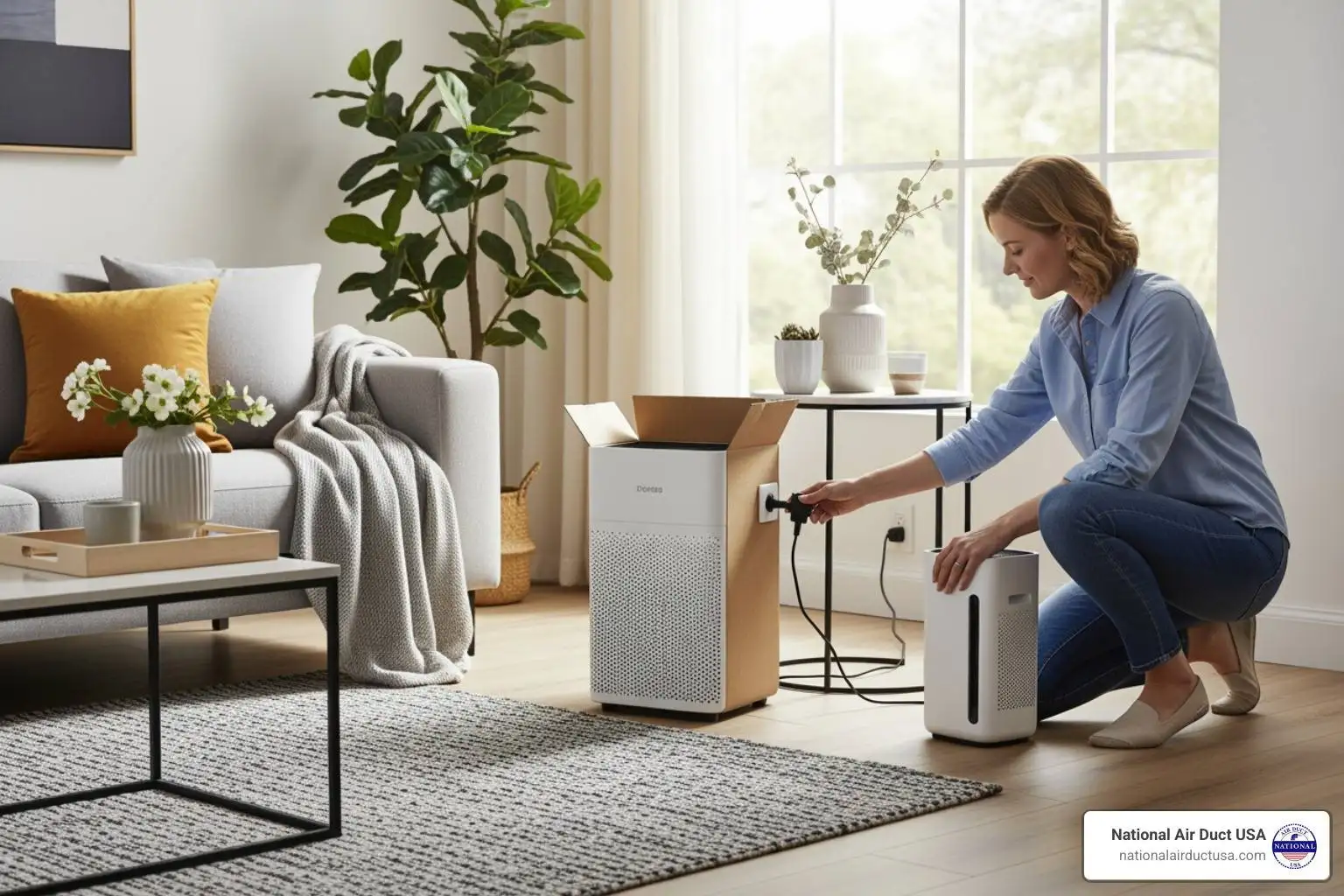
Why Clean Indoor Air Starts with the Right Setup
Air purifier installation can be as simple as plugging in a portable unit or as complex as integrating a whole-house system into your HVAC. Understanding your options helps you breathe easier—literally.
Quick Guide to Your Installation Options:
| Type | Installation Complexity | Coverage | Best For |
|---|---|---|---|
| Portable Units | Simple plug-and-play | Single room (up to 500 sq ft) | Bedrooms, offices, targeted relief |
| Whole-House Systems | Professional HVAC integration | Entire home | Comprehensive air quality, HVAC efficiency |
| UV Light Add-ons | Professional electrical work | Full system sterilization | Mold prevention, germ reduction |
The numbers tell a sobering story. The EPA has found that indoor air can contain 2-5 times more pollutants than outdoor air—sometimes even 100 times more. For Long Island homeowners dealing with seasonal allergies, pet dander, and coastal humidity, that’s not just a statistic. It’s a daily reality affecting your family’s health.
Poor indoor air quality ranks among the top five environmental threats we face. The CDC estimates it costs American businesses $60 billion annually in lost productivity. Recent studies from Harvard and the State University of New York even found a correlation between indoor air quality and cognitive functions.
Whether you’re considering a simple portable unit for your bedroom or a whole-house system that works with your existing HVAC, this guide walks you through every option. We’ll cover what works, what doesn’t, and when you need a professional like National Air Duct USA to ensure your installation protects your investment and your health.
Relevant articles related to air purifier installation:
Choosing the Right System for Your Home
When it comes to improving your indoor air quality in Long Island, the first step is understanding the different types of air purifiers available and how they work. Each technology targets specific pollutants, offering unique benefits and considerations for air purifier installation.
- HEPA Filters: These are the workhorses of air purification, capturing an impressive 99.97% of particles as small as 0.3 microns. This includes common allergens like dust, pollen, pet dander, and mold spores, as well as bacteria. If allergies or asthma are a primary concern for your family in Hempstead or Garden City, a HEPA filter is non-negotiable. You can learn more about HEPA filter efficiency and particle capture.
- Activated Carbon Filters: While HEPA filters tackle particles, activated carbon excels at absorbing odors and gases. Think cooking smells, pet odors, tobacco smoke, and volatile organic compounds (VOCs) that can off-gas from furniture or cleaning products. Many purifiers combine HEPA and activated carbon for comprehensive coverage.
- UV Light Purifiers (Germicidal Lamps): These systems use UVC wavelength light to damage the DNA of airborne microorganisms like mold spores, bacteria, and viruses, preventing them from reproducing. They are particularly effective when integrated into your HVAC system, continuously sterilizing air as it flows past inside your unit. UV lights are excellent at preventing mold growth on the evaporator coil and stopping bacteria before it spreads through ductwork. However, UV light targets germs but doesn’t remove dust or larger allergens, so it’s best paired with a HEPA or advanced filter system. Safety is paramount with UV lights, as UVC light is powerful and can be harmful to eyes and skin.
- PCO (Photocatalytic Oxidation) Technology: This advanced method combines UV light with a titanium dioxide catalyst to neutralize VOCs, odors, and biological contaminants. It’s an even more proactive approach to breaking down harmful airborne chemicals and pathogens.
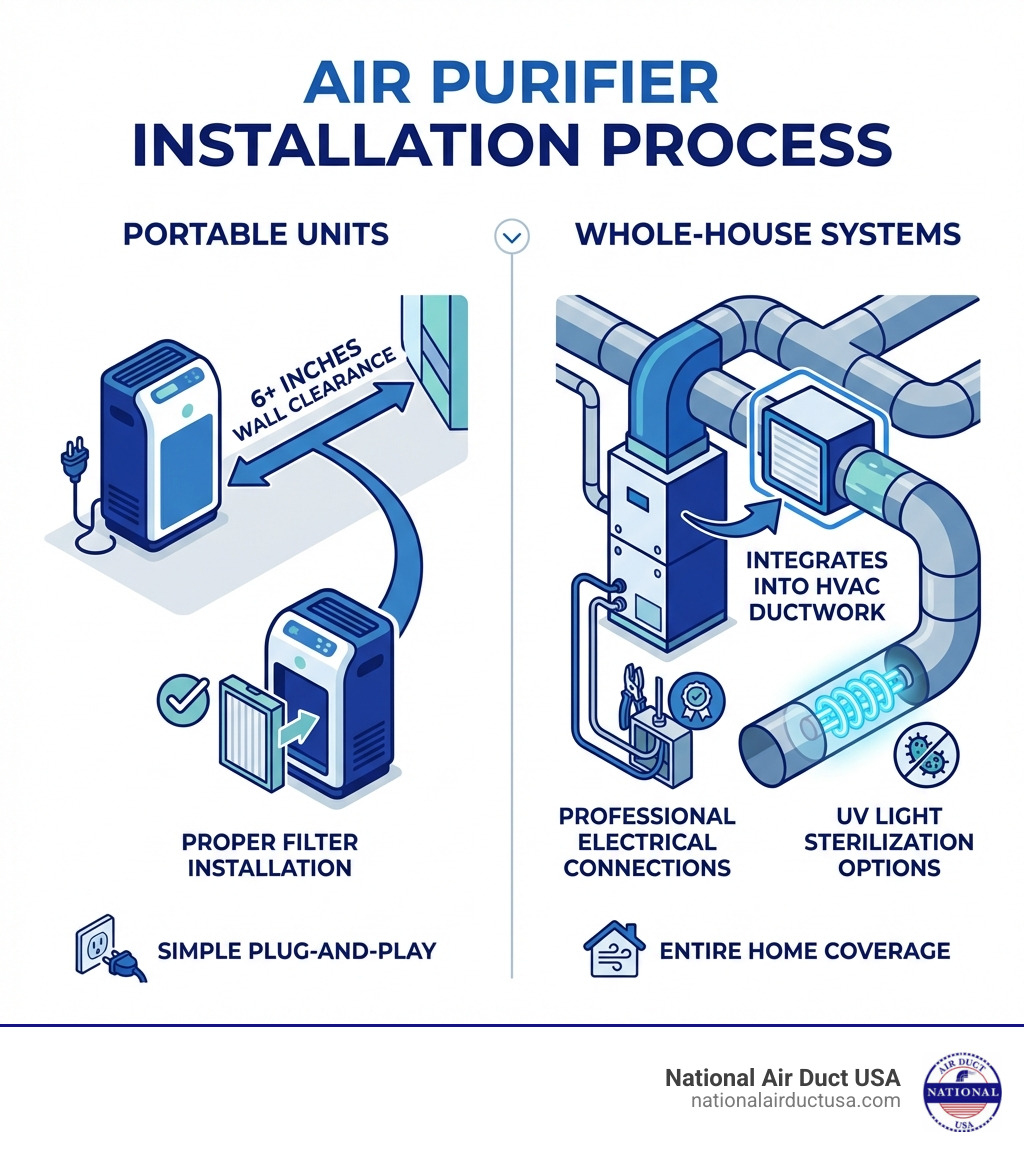
The choice between a portable unit and a whole-house system largely dictates the complexity and cost of air purifier installation. Portable units are typically plug-and-play, offering targeted relief for a single room. Whole-house systems, on the other hand, integrate directly into your HVAC system, purifying the air throughout your entire home.
The national average for central air cleaner installation, which includes whole-house air purifiers, can range from $456 to $4,557. This wide range reflects factors like the type of system (a basic media filter costs less than a sophisticated UV light purifier), the size of your home in Nassau County, and the condition of your existing ductwork. While a portable unit might be a quick DIY, a whole-house system often requires professional expertise for proper electrical wiring and duct modifications.
Key Steps for Portable air purifier installation
Portable air purifiers are designed for straightforward setup, making them a popular choice for quick relief in specific areas of your home. We’ve consulted user manuals from leading brands like Honeywell, Shark, Levoit, and Crane, and the basic steps are consistent:
- Unpack and Prepare: Remove the unit from its packaging. Crucially, always remove any plastic packaging from the filters before installing them. Many new units come with filters pre-installed but still wrapped in plastic for protection during shipping. Failing to remove this plastic is a common mistake that renders your purifier ineffective.
- Install Filters: Place the filters into their designated slots, ensuring they are oriented correctly (look for arrows indicating airflow).
- Position for Optimal Airflow: This is where many people miss out on maximum efficiency. While many manufacturers recommend at least 6 inches of clearance from walls and furniture, some units, like Levoit, suggest a minimum of 15 inches, and Crane units can require up to 3 feet. Always check your specific model’s manual.
- Connect to Power: Plug the unit into a standard electrical outlet.
- Turn On and Adjust: Power on the unit and select your desired settings.
Common mistakes to avoid during portable air purifier installation:
- Not removing filter packaging: As mentioned, this is the number one culprit for poor performance.
- Blocking grilles: Ensure the air intake and output grilles are clear of furniture, curtains, or other obstacles. An obstructed grille severely limits airflow and purification.
- Placing it directly against a wall: Even if your manual says 6 inches, giving it more space, and facing the purifier into the room rather than towards a wall, significantly improves circulation. A unit against a wall can have its airflow reduced to just 5% of its potential.
Positioning for Optimal Performance
Where you place your air purifier can be almost as important as the unit itself. Strategic placement ensures your purifier works at peak efficiency, especially for portable units in a specific room.
- Avoid “Dead Zones”: Corners are the enemy of good airflow. Placing a purifier in a corner can create a “dead zone” where air doesn’t circulate well, reducing the purifier’s effectiveness. Similarly, avoid placing it behind large furniture or directly against a wall, as these obstructions block airflow.
- Central Locations are Best: For optimal performance, position your air purifier in a central location within the room where you spend the most time. This allows for even air distribution and maximum pollutant capture. For example, in a bedroom, placing it near the center of the room or slightly off-center will be more effective than tucked away in a corner.
- Consider Room Size and CADR: When selecting a portable unit, match its Clean Air Delivery Rate (CADR) to your room size. A small unit in a large room will struggle to purify the air effectively. For instance, a small room might be 299 sq. ft. or less, while an extra-large room could be 499 sq. ft. or more. Our guide on Strategic placement for maximum effectiveness offers more detailed insights.
- Maintain Clearance: Reiterate the importance of maintaining at least 6 inches of clearance from walls and furniture. This ensures unrestricted airflow, allowing the unit to draw in and release purified air efficiently.
By giving your air purifier room to breathe, you’re helping it clean your air more effectively, making your home in Freeport or Hicksville a healthier place.
Integrating Whole-House air purifier installation with HVAC
For comprehensive air purification throughout your entire home in Nassau or Suffolk County, a whole-house air purifier system integrated with your HVAC is the ultimate solution. This type of air purifier installation is more involved and typically requires professional expertise.
Our NADCA-certified technicians at National Air Duct USA are experts in integrating these systems seamlessly into your existing ductwork. The process generally involves:
- Ductwork Integration: The air purifier unit is installed directly into the main supply or return duct of your HVAC system. This ensures that all air circulating through your heating and cooling system passes through the purification unit.
- Plenum Mounting: Depending on the system, the unit might be mounted near the evaporator coil, air handler, or inside the plenum. This strategic placement maximizes its effectiveness in capturing pollutants before they are distributed throughout your home.
- UV Light Integration: If you opt for a UV light air purifier, it will be wired directly into your HVAC system. These “germicidal lamps” are particularly effective at preventing mold growth on the evaporator coil and sterilizing air as it passes through the system. This can significantly reduce bacteria and mold spores before they ever reach your living spaces. For more information on this specialized service, visit our UV Light Installation page.
- UVC Safety and Electrical Considerations: Installing UV light models requires careful handling. UVC light is harmful to eyes and skin, so direct exposure must be avoided. Professional installation is crucial here, as it involves electrical wiring and ensures that all connections are secure and comply with local electrical codes. Our technicians also ensure that all joints and seams near the mounting location are properly sealed to prevent any UV light leaks, protecting your family and pets. We always wear gloves when handling UV lamps to maintain their integrity.
- Professional Testing: After installation, our team conducts thorough testing to ensure the system is functioning correctly, there are no air leaks, and the purification process is fully operational.
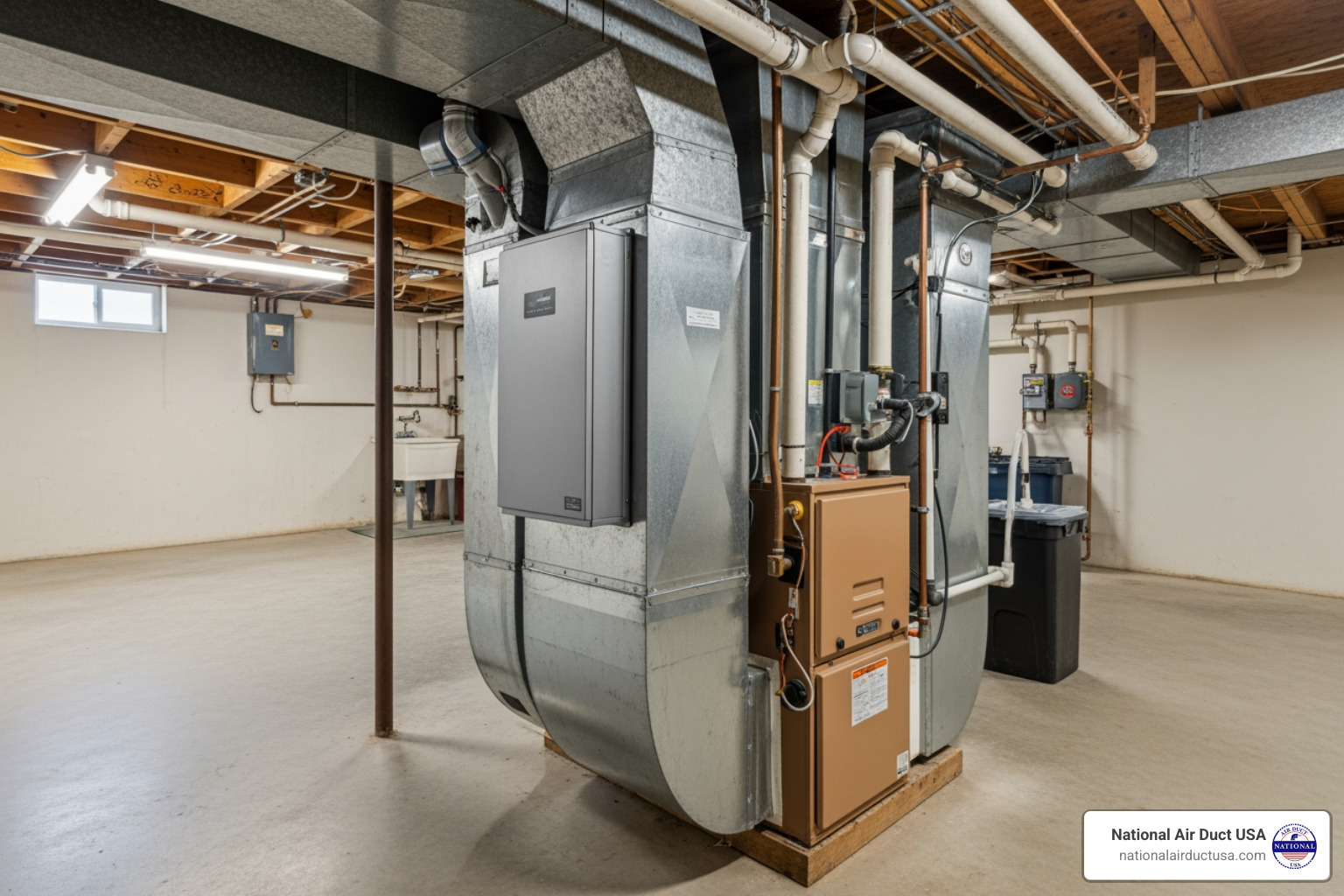
A whole-house air purifier installation provides consistent, whole-home air quality improvement, working silently in the background. It also helps protect your HVAC system itself by reducing the buildup of contaminants like mold and bacteria on internal components.
Maintenance and Long-Term Air Quality
Like any essential home appliance, your air purifier requires regular maintenance to perform effectively and efficiently. Neglecting maintenance can lead to decreased performance, and in some cases, even recirculate trapped pollutants back into your air.
- Filter Replacement: This is the most crucial maintenance task. HEPA filters typically need to be replaced every 6 to 12 months, while activated carbon filters, which absorb odors and gases, usually require attention every 3 to 6 months. These intervals can vary based on usage, air quality in your home, and manufacturer recommendations. If you notice decreased airflow, increased noise from the unit, or persistent odors, it’s a strong indicator that your filters need changing.
- UV Bulb Lifespan: For UV light purifiers, the germicidal bulbs have a finite lifespan. They typically need replacement after about two years, as their germ-killing effectiveness diminishes over time, even if they still appear to be glowing.
- Cleaning the Unit: Periodically clean the exterior of your portable unit with a soft cloth and vacuum or rinse washable pre-filters (if applicable). For whole-house systems, professional annual inspections are recommended to check all components and ensure optimal function.
Maintaining your air purifier is a vital part of your overall indoor air quality strategy. However, it’s important to understand that an air purifier, while powerful, doesn’t replace the need for other crucial maintenance. The EPA highlights that indoor air quality is one of the top five environmental threats, and dirty HVAC systems are a major contributor.
This brings us to the critical role of Air Duct Cleaning and HVAC System Cleaning. Air purifiers clean the air passing through them, but they don’t remove the accumulated dust, debris, mold, and allergens that cling to the inside surfaces of your air ducts and HVAC components. These contaminants can be significant sources of indoor air pollution. The United States Centers for Disease Control estimates a loss of $60 billion dollars a year in productivity due to poor indoor air quality, and studies from Harvard/State University of New York found a correlation between indoor air quality and cognitive functions. By regularly cleaning your air ducts and HVAC system, you remove these built-up pollutants, allowing your air purifier to work more effectively and your entire system to run more efficiently.
When to Call a Pro for air purifier installation
While portable air purifiers are generally DIY-friendly, certain situations, especially involving whole-house systems or UV light add-ons, make professional air purifier installation not just recommended, but often essential.
- Electrical Wiring: Integrating a whole-house air purifier, particularly one with UV lights or advanced electronic components, requires connecting it directly to your home’s electrical system and often your HVAC unit’s power supply. This demands electrical know-how to ensure safety and compliance with local codes in areas like Westbury and Hempstead. Our NADCA-certified technicians are experienced in handling these electrical connections securely and correctly.
- Duct Modifications: Whole-house air purifiers are installed within your HVAC ductwork. This often involves cutting into the ducts to create an access point for the unit. Improper cuts or sealing can lead to air leaks, reducing system efficiency and potentially causing other HVAC issues. Professionals have the right tools and expertise to make precise modifications and ensure airtight seals.
- Warranty Protection: Attempting a complex air purifier installation yourself could inadvertently void the warranty on both your new air purifier and, potentially, your existing HVAC system. Professional installation ensures that the work is done to manufacturer specifications, preserving your warranties.
- System Compatibility: An expert can assess your existing HVAC system to ensure the chosen whole-house air purifier is fully compatible and will integrate seamlessly without negatively impacting your heating and cooling performance.
- Professional Testing: After a professional installation, our team will thoroughly test the entire system to confirm that the air purifier is functioning optimally, that there are no air leaks, and that your HVAC system is operating efficiently with the new addition. This provides peace of mind that your investment is working as intended.
For any whole-house air purifier installation or complex UV light integration in Long Island, we highly recommend calling a professional. It ensures safety, efficiency, and the longevity of your system.
Frequently Asked Questions about Air Purifier Setup
We often hear similar questions from homeowners in Nassau and Suffolk Counties when they’re considering air purifier installation. Let’s clear the air on some of the most common concerns.
How often should I replace my filters and UV bulbs?
This is a critical question for maintaining effective air purification.
- HEPA filters typically need swapping every 6-12 months. This timeframe can shorten if you live in an area with high pollution, have pets, or use your purifier frequently.
- Activated carbon filters usually require attention every 3-6 months because they absorb odors and gases, and once saturated, their effectiveness diminishes.
- UV bulbs generally need replacement after about two years. While they may still glow, their germicidal intensity fades over time. Always check your specific manufacturer’s recommendations for the most accurate timeline. For more details on UV light services and maintenance, you can check our page on More info about UV light services.
Where is the worst place to put a portable air purifier?
To get the most out of your portable air purifier, avoid these common placement mistakes:
- Corners: As we mentioned, corners are “dead zones” where air circulation is poor. Your purifier won’t be able to draw in and distribute air effectively.
- Behind large furniture: Placing a unit behind a sofa or bookshelf will block its intake and output grilles, severely restricting airflow and rendering it largely ineffective.
- Directly against a wall: Even if the manual allows it, giving your unit a few extra inches of clearance and facing it into the room improves performance dramatically.
- High-humidity zones: Unless specifically designed for bathrooms or other humid environments, placing a standard air purifier in such areas can damage the unit or encourage mold growth within the device itself.
- Dead air spaces: Any area where airflow is naturally restricted or stagnant will not allow the purifier to work efficiently.
Optimal placement helps your air purifier clean your air up to 20% more efficiently.
Can an air purifier replace regular air duct cleaning?
This is a common misconception, and the answer is a resounding no. An air purifier and air duct cleaning serve different, complementary purposes.
- Air purifiers filter the air that passes through them, removing airborne particles and contaminants. They are excellent at maintaining clean air after it has been drawn into the system.
- Air duct cleaning, however, addresses the source of many pollutants that accumulate within your HVAC system’s ductwork. Over time, dust, pet dander, mold, bacteria, and other debris can build up on the interior surfaces of your ducts. An air purifier cannot reach these surfaces to remove this accumulation.
- Pollutant accumulation: If your ducts are full of dust and mold, your air purifier will constantly be trying to filter these particles as they are stirred up and circulated. Regular Air Duct Cleaning removes this buildup directly, preventing it from becoming airborne in the first place. This allows your air purifier to work more efficiently on new contaminants.
- System efficiency: Dirty air ducts restrict airflow, forcing your HVAC system to work harder and increasing energy costs. Cleaning the ducts improves airflow and overall system efficiency, which then allows your air purifier to operate more effectively.
- Dust removal: We often find significant amounts of dust, allergens, and even construction debris in ducts in areas like Westbury. An air purifier alone won’t remove these trapped pollutants.
Think of it this way: an air purifier is like a great coffee filter, but air duct cleaning is like cleaning the coffee maker itself. You need both for the best, cleanest brew. For more information on why this service is essential, check out Why regular air duct cleaning is essential for every home in Long Island and Westbury.
Conclusion
Improving your indoor air quality is one of the most impactful steps you can take for your health and the comfort of your home in Long Island, Nassau County, or Suffolk County. Whether you choose the flexibility of a portable unit or the comprehensive coverage of a whole-house system, understanding the nuances of air purifier installation is key to open uping its full potential.
From selecting the right filtration technology—HEPA, activated carbon, UV light, or PCO—to ensuring optimal placement and adhering to a consistent maintenance schedule, every decision contributes to the long-term benefits of cleaner air. These benefits extend beyond just easier breathing, impacting everything from reduced allergy symptoms to improved cognitive function and overall well-being.
At National Air Duct USA, we pride ourselves on being your trusted partner for creating a healthier indoor environment. Our NADCA-certified technicians in Long Island and Westbury are equipped with the expertise to guide you through selecting the perfect air purification solution for your home and performing professional air purifier installation with transparent pricing and 100% satisfaction guaranteed.
Don’t let indoor air pollutants compromise your family’s health or your home’s comfort. Let us help you take a breath of fresh air. Explore our full range of services and find how our professional expertise can transform your indoor air quality. Breathe easier with our full range of services.