PTAC Cleaning in Long Island NY: Complete 2026-2027 Guide for Homeowners and Property Managers
Quick Answer
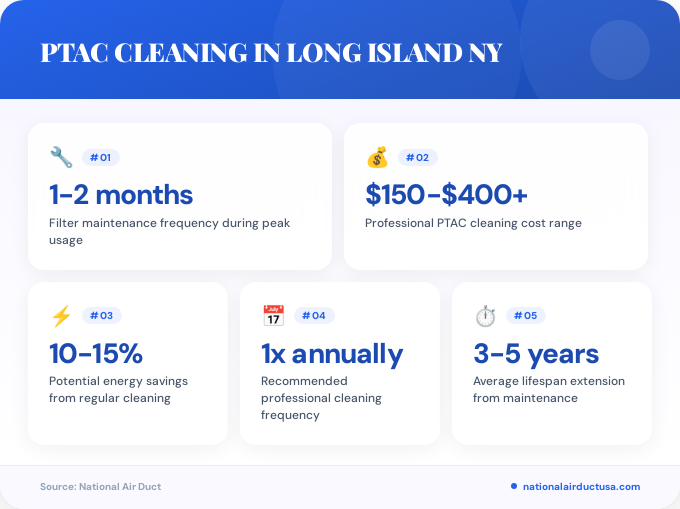
PTAC cleaning in Long Island NY should be performed at least once annually by professionals, with filter maintenance every 1-2 months during peak usage. Professional cleaning costs typically range from $150 to $400+ depending on unit condition and services required, while delivering 10-15% energy savings and preventing costly mold and drainage issues common in Long Island’s humid coastal climate.
Did you know that neglecting PTAC cleaning in Long Island NY can increase your cooling costs by up to 15% and potentially lead to complete system failure in units over 15 years old? With over 2.7 million residents across Nassau and Suffolk Counties relying on these self-contained heating and cooling systems, proper maintenance has never been more critical.
Packaged Terminal Air Conditioning (PTAC) units are the workhorses of Long Island’s residential and hospitality sectors, found in thousands of apartments, motels, and converted residential properties. Unlike central HVAC systems, these all-in-one units sit at floor or wall level, combining heating, cooling, and ventilation in a single chassis. However, Long Island’s unique coastal humidity and seasonal temperature swings create maintenance challenges that demand specialized attention.
This comprehensive guide covers everything property owners, facility managers, and homeowners need to know about maintaining these essential climate control systems in 2026-2027, backed by real-world data from Long Island HVAC professionals and industry insights.
What Is PTAC Cleaning and Why Does It Matter in Long Island?
PTAC cleaning refers to the comprehensive maintenance process that keeps Packaged Terminal Air Conditioning units running efficiently and safely. Unlike simple filter changes, professional PTAC cleaning in Long Island NY addresses components that homeowners can’t easily access: evaporator and condenser coils, drainage systems, fan assemblies, and internal pathways where mold, dust, and salt air residue accumulate.
These units face unique challenges in Long Island’s environment. The proximity to Atlantic Ocean breezes means salt-laden air accelerates corrosion on metal components. High humidity levels during summer months create ideal conditions for mold growth inside drainage pans and on evaporator coils. Winter heating cycles compound these issues, creating condensation that can freeze and crack components if not properly maintained.
According to industry maintenance guidelines, professional PTAC cleaning extends unit lifespan by 3-5 years on average, prevents refrigerant leaks, maintains indoor air quality, and ensures the system operates at manufacturer-specified efficiency levels. Given that PTAC replacement costs range from $1,500 to $4,000+ per unit including installation, regular cleaning is a cost-effective investment.
How Does Long Island’s Climate Affect PTAC Maintenance Needs?
Long Island’s climate presents specific challenges that make regular PTAC maintenance more critical here than in drier or more temperate regions. The area experiences hot, humid summers with temperatures regularly reaching 85-90°F and relative humidity often exceeding 70%. These conditions force PTAC units to work harder and longer, accumulating more condensation and airborne particulates.
Winter temperatures dropping to 20-30°F mean these units also operate in heating mode for extended periods. The constant cycling between heating and cooling creates thermal stress on components and increases condensation formation. Coastal proximity introduces salt spray that deposits on external grilles and finds its way into internal components, accelerating oxidation.
“In coastal areas like Long Island, we see significantly higher mold and corrosion rates in PTAC units compared to inland properties. The combination of salt air and humidity creates a perfect storm for component degradation if units aren’t maintained on a strict annual schedule. Properties near the water should consider twice-yearly professional service.” – HVAC maintenance specialist, Long Island City
The seasonal transitions are particularly taxing. Spring and fall bring pollen, leaves, and debris that clog external vents and filters. These same periods often see property owners neglecting their PTAC units during “off-season” months, allowing buildup to accumulate unchecked. By the time they switch the unit back on for summer or winter, substantial cleaning is required to restore proper function.
How Often Should You Schedule PTAC Cleaning in Long Island NY?
Professional PTAC cleaning in Long Island NY should occur at minimum once annually, ideally in late spring before peak cooling season. However, usage patterns and environmental factors may necessitate more frequent service. Properties within one mile of the coast, units in high-occupancy rentals, or systems running year-round should consider bi-annual professional cleaning.
Between professional services, property owners should maintain filters on a consistent schedule. During heavy-use periods (June through September for cooling, December through March for heating), filters require inspection and cleaning every 1-2 months. Light-use periods can extend to quarterly filter maintenance.
| Maintenance Task | Frequency | Recommended For |
|---|---|---|
| Filter inspection/cleaning | Every 1-2 months | Peak usage seasons |
| Professional deep cleaning | Once annually | All PTAC owners |
| Coil inspection | Twice annually | Coastal properties |
| Drainage system check | Seasonally | Before summer/winter |
Data from local PTAC service providers indicates that approximately 15% of units over 15 years old experience complete cooling failure immediately after neglected systems receive their first professional cleaning in years. This counterintuitive outcome occurs because the cleaning process reveals underlying component failures that were masked by reduced airflow. Regular annual cleaning prevents this scenario by catching small issues before they cascade into major failures.
What’s the Difference Between Professional and DIY PTAC Maintenance?
Homeowners can handle certain PTAC maintenance tasks safely and effectively, but professional service addresses components and issues beyond DIY capabilities. Understanding this division helps property owners maximize value while ensuring critical maintenance isn’t overlooked.
DIY maintenance includes: Filter removal, cleaning, and reinstallation, external grille cleaning, cabinet surface wiping, basic debris removal from visible components, and monitoring for unusual sounds or odors. These tasks require no special tools and can be completed in 15-30 minutes. Washable filters should be rinsed with water, allowed to dry completely, and reinstalled within 24 hours.
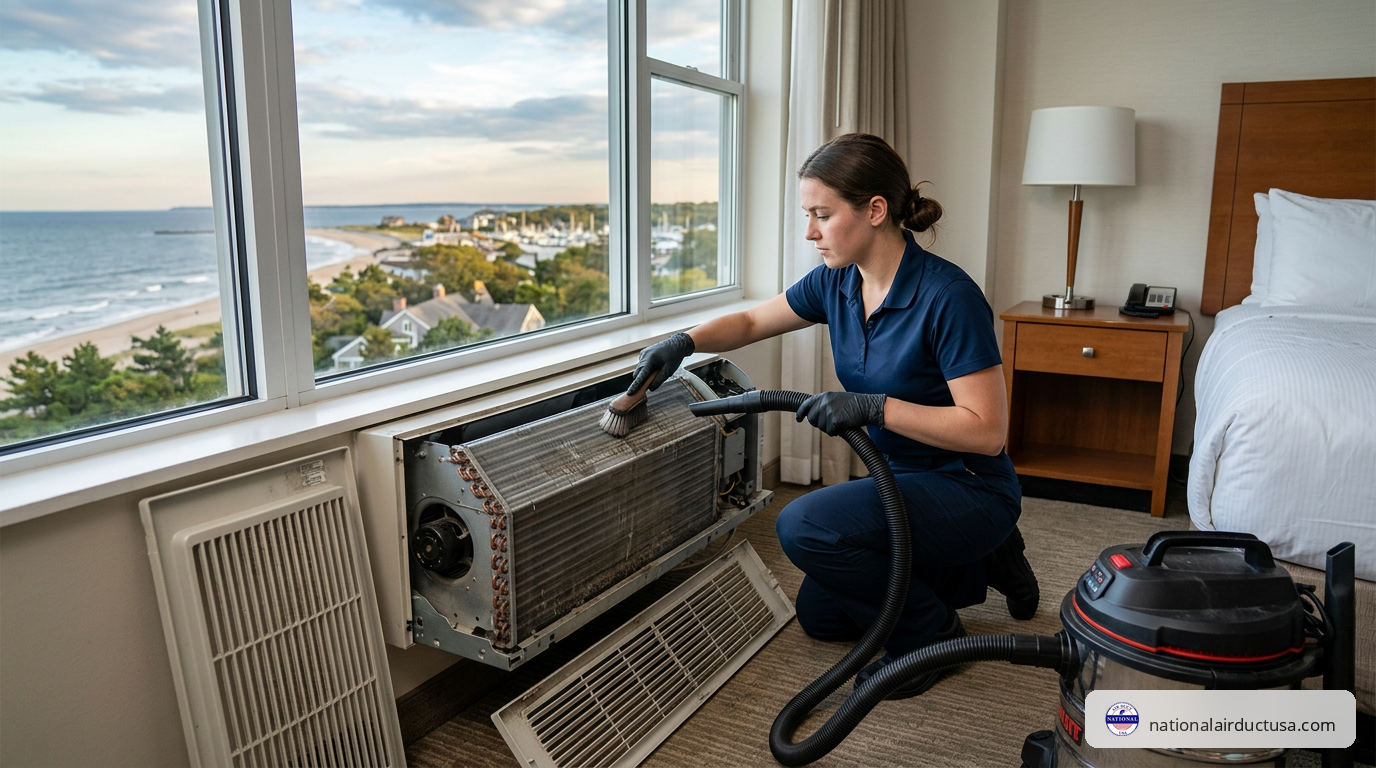
Professional PTAC cleaning in Long Island NY encompasses: Complete disassembly of the chassis, evaporator and condenser coil chemical cleaning, fan motor lubrication, drainage pan sanitization and clearing, refrigerant level verification, electrical connection inspection, thermostat calibration, and reassembly with operational testing. This comprehensive service typically requires 1-2 hours per unit and specialized equipment including coil cleaners, pressure washers, and refrigerant gauges.
Similar to commercial air duct cleaning services, professional PTAC maintenance requires expertise to avoid damaging sensitive components like coil fins or refrigerant lines. Technicians also identify developing problems like refrigerant leaks, failing capacitors, or worn fan bearings before they cause complete system failure.
The hybrid approach recommended by HVAC professionals involves homeowners handling routine filter maintenance and external cleaning while scheduling annual professional deep cleaning. This model balances cost-effectiveness with thorough maintenance, extending unit life without excessive service calls.
What Does Professional PTAC Cleaning Cost in Long Island?
Professional PTAC cleaning costs in Long Island vary significantly based on multiple factors, with pricing typically ranging from $150 to $400+ per unit. Understanding these cost drivers helps property owners budget appropriately and recognize reasonable pricing versus inflated quotes.
Primary cost factors include: Unit condition and age (heavily neglected units require more labor and cleaning chemicals), accessibility (units in difficult-to-reach locations command higher rates), service provider expertise (specialized PTAC technicians versus general HVAC contractors), additional services needed (repair work, parts replacement, refrigerant recharge), and property location within Long Island (Nassau County versus eastern Suffolk County pricing variations).
Multi-unit properties often receive volume discounts. Buildings with 5+ PTAC units may negotiate rates of $100 to $250 per unit when servicing all units simultaneously. However, pricing ultimately depends on the scope of work required, material costs, and the expertise level of the service provider. Premium providers emphasize thorough service and long-term reliability over lowest-cost options.
Typical Range: $150-$200
Best For: Recently serviced units
Typical Range: $200-$300
Best For: Annual maintenance schedule
Typical Range: $300-$400+
Best For: Neglected or older units
Typical Range: $350-$500+
Best For: Mid-summer failures
When evaluating service quotes, prioritize providers who offer detailed written estimates specifying exactly what services are included. The cheapest option often means rushed work or incomplete service that creates problems down the line. As with other specialized HVAC services in Long Island, quality workmanship and thoroughness deliver better long-term value than rock-bottom pricing.
Property owners should request custom quotes based on their specific units and needs rather than relying on advertised averages. Factors like unit brand, installation accessibility, and building type all influence final pricing.
What Are the Warning Signs Your PTAC Unit Needs Cleaning?
Recognizing early warning signs allows property owners to address PTAC maintenance needs before minor issues escalate into costly repairs or complete system failures. Long Island homeowners should monitor their units for these telltale indicators:
Reduced airflow: Weak air output from vents, even on maximum fan speed, signals clogged filters or dirty coils restricting air movement. This is the most common symptom of needed maintenance.
Unusual odors: Musty, moldy smells indicate biological growth in drainage pans or on evaporator coils. This is particularly common in Long Island’s humid climate and poses potential health concerns for occupants.
Water sounds or leaks: Gurgling noises or visible water pooling around the unit suggest blocked drainage systems. Condensate should drain silently and completely. Standing water promotes mold growth and can damage flooring.
Higher energy bills: Unexplained increases in electricity costs, particularly during peak usage months, often trace back to HVAC systems working harder due to reduced efficiency from dirt buildup.
Uneven temperature control: Rooms that won’t reach set temperature or cycle on and off frequently indicate the system isn’t operating at proper capacity. Dirty coils reduce heat transfer efficiency dramatically.
Visible dust or debris: Dust particles blowing from vents or visible accumulation on external grilles means internal components are certainly worse. Similar to issues addressed in air duct contamination scenarios, this impacts air quality and system performance.
Extended run times: Units that run continuously without cycling off are working too hard to maintain temperature, usually due to reduced capacity from maintenance neglect.
What Does Professional PTAC Cleaning Include?
Understanding the professional PTAC cleaning process helps property owners appreciate the value of expert service and recognize thorough work versus superficial cleaning. Reputable Long Island providers follow comprehensive protocols developed over decades of industry experience.
Step 1: Initial Assessment – Technicians test unit operation, document current performance metrics, and identify any immediate concerns. They note airflow strength, temperature differential, unusual sounds, and visible damage.
Step 2: Safe Shutdown and Disassembly – Units are powered down and disconnected. The chassis is carefully removed from its sleeve, preserving electrical connections and refrigerant lines. Experienced technicians work methodically to avoid damage to sensitive components.
Step 3: Filter and Exterior Cleaning – Filters are thoroughly cleaned or replaced. External grilles, louvers, and cabinet surfaces are wiped down and sanitized. Salt residue and environmental deposits are removed from all accessible surfaces.
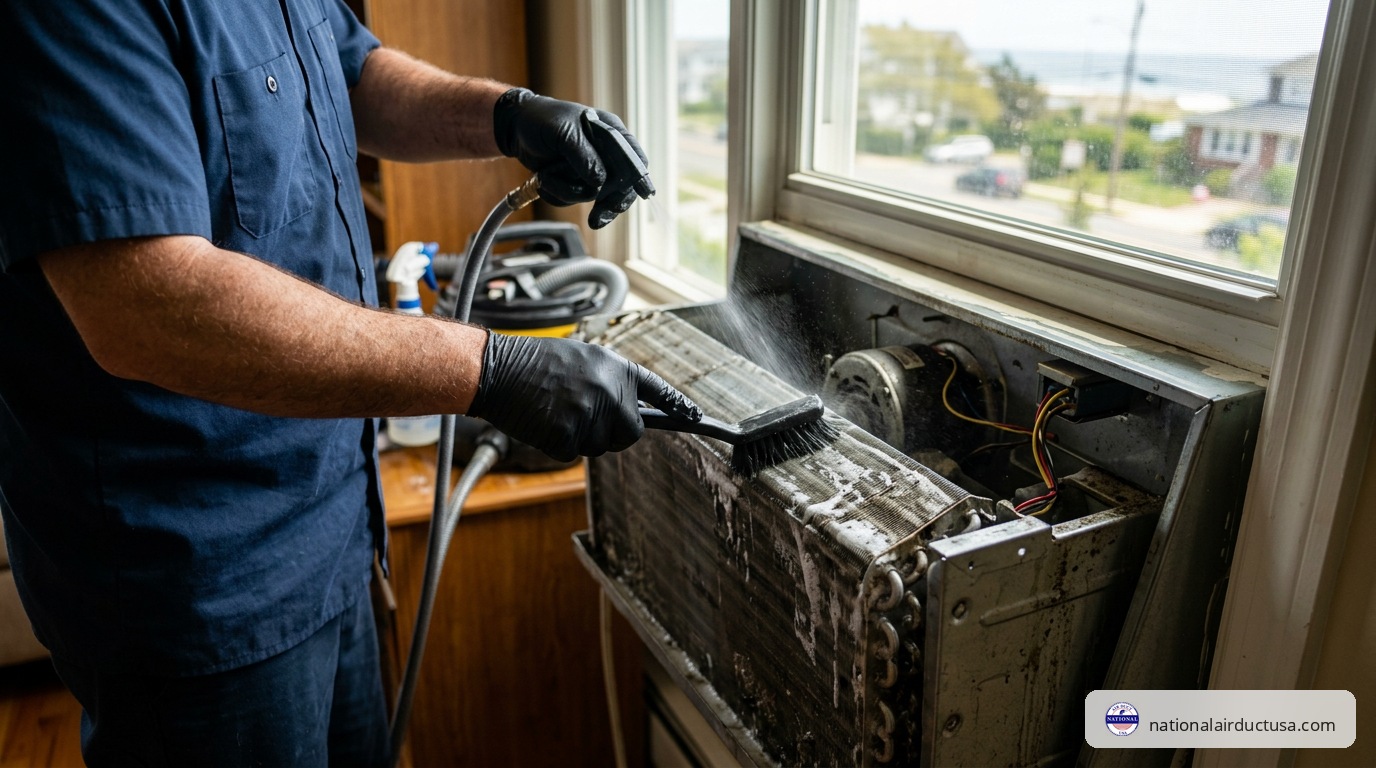
Step 4: Coil Treatment – This is the critical phase distinguishing professional service from DIY attempts. Technicians apply specialized coil cleaners to both evaporator and condenser coils, allowing chemicals to break down accumulated grime. High-pressure (but carefully controlled) rinsing removes loosened debris without damaging delicate fins.
Step 5: Drainage System Maintenance – Condensate pans are emptied, sanitized with antimicrobial solutions, and cleared of any biological growth. Drain lines are flushed to ensure proper water evacuation. Drain holes are verified clear and functioning.
Step 6: Fan and Motor Service – Blower wheels are cleaned of accumulated dust. Motors receive lubrication if applicable. Bearings are inspected for wear. Electrical connections are tightened and inspected for corrosion.
Step 7: Refrigerant and Controls Check – While not full HVAC service, cleaning appointments include verification of proper refrigerant levels and thermostat operation. Any concerns are documented for follow-up service.
Step 8: Reassembly and Testing – Units are carefully reassembled, reinstalled, and power-restored. Technicians run the system through complete heating and cooling cycles, verifying proper operation and documenting performance improvements.
This comprehensive process typically requires 60-120 minutes per unit depending on condition. According to maintenance specialists serving the New York metro area, thorough cleaning delivers measurable performance improvements: 20-30% airflow increase, 10-15% energy efficiency gains, and elimination of biological contaminants.
How Much Money Can Regular PTAC Cleaning Save You?
The financial benefits of regular PTAC cleaning in Long Island NY extend well beyond the service cost itself. Property owners who maintain consistent cleaning schedules realize substantial savings through multiple channels over the unit’s lifespan.
Energy cost reduction: Clean PTAC units operate 10-15% more efficiently than neglected systems. For a unit consuming 1,500 kWh annually for cooling and heating (typical for Long Island climate), this efficiency gain saves approximately 150-225 kWh per year. At Long Island’s average residential electricity rate of $0.20-0.25 per kWh, annual savings reach $30-55 per unit. Multi-unit properties multiply these savings substantially.
Extended equipment lifespan: Well-maintained PTAC units reliably operate 12-15 years, while neglected systems often fail after 8-10 years. Given replacement costs of $1,500-$4,000+ per unit including installation, three extra years of operation represents massive savings compared to annual cleaning costs of $150-$300.
Avoided repair costs: Regular maintenance catches small issues like worn fan belts, minor refrigerant leaks, or failing capacitors before they cause cascading damage. A $200 annual cleaning prevents $500-$1,500 emergency repair calls during peak season when technician availability is limited and rates are premium.
Improved indoor air quality: While harder to quantify financially, cleaner air reduces potential health impacts and associated costs. This proves particularly valuable for properties housing vulnerable populations or those concerned about respiratory health.
| Cost Factor | Annual Savings Range |
|---|---|
| Energy efficiency gains | $30-$55 per unit |
| Extended equipment life (amortized) | $125-$300 per unit |
| Avoided emergency repairs | $100-$400 per unit |
Property managers overseeing multiple units should view regular PTAC maintenance as profit preservation rather than optional expense. A 10-unit apartment building spending $2,000 annually on comprehensive PTAC cleaning potentially saves $2,500-$7,500 yearly through combined energy savings, extended equipment life, and avoided repairs.
How to Choose the Right PTAC Cleaning Service in Long Island
Selecting a qualified PTAC service provider in Long Island requires evaluating several key factors beyond advertised pricing. The right choice delivers reliable service, protects your investment, and ensures long-term system performance.
Specialized PTAC experience: Prioritize providers with specific PTAC expertise over general HVAC contractors. PTAC units have unique characteristics (through-wall installation, self-contained design, specialized drainage) that require targeted knowledge. Ask how many PTAC units they service annually and request references from similar properties.
Licensing and insurance: Verify New York State HVAC licensing and adequate liability insurance. This protects property owners if service work causes damage. Reputable providers willingly provide proof of credentials.
Detailed service descriptions: Quality providers clearly explain what their service includes. Avoid companies offering vague “tune-up” or “maintenance” descriptions without specifics about coil cleaning, drainage service, or testing protocols.
Written estimates and guarantees: Request detailed written quotes specifying services, pricing, and any guarantees on work performed. Verbal quotes or handshake agreements create disputes if problems arise.
Local presence and reputation: Companies with established Long Island operations and positive local reviews demonstrate reliability. Check ratings on multiple platforms and look for consistent positive feedback about thoroughness and professionalism. Local HVAC specialists understand regional climate challenges and building types.
Response times and scheduling: During peak seasons, PTAC failures create emergencies. Providers offering reasonable response times and flexible scheduling demonstrate customer commitment.
Transparent pricing structure: While exact costs vary by project, quality providers explain their pricing factors and avoid surprise charges. Be wary of companies that won’t discuss pricing ranges until after inspection.
Maintenance program options: Providers offering annual maintenance agreements or multi-unit discounts help property owners stay on schedule while managing costs effectively.
Property owners should interview 2-3 providers before making decisions. The lowest bid rarely represents the best value when equipment longevity and reliable comfort are priorities. Investing in thorough, professional service pays dividends through extended equipment life and consistent performance.
Key Takeaways
- Annual professional PTAC cleaning is essential in Long Island’s humid coastal climate, with filter maintenance every 1-2 months during peak usage seasons
- Professional service costs range from $150 to $400+ per unit depending on condition, location, and services required, but delivers 10-15% energy savings and extends equipment life by 3-5 years
- Long Island’s salt air and humidity create unique maintenance challenges that make specialized PTAC service providers preferable to general HVAC contractors
- DIY filter cleaning and professional annual deep cleaning represent the optimal maintenance approach, balancing cost-effectiveness with thorough care
- Warning signs including reduced airflow, unusual odors, and water sounds indicate immediate cleaning needs before minor issues become costly failures
- Regular maintenance saves substantially through reduced energy costs, avoided repairs, and extended equipment lifespan compared to neglected systems
- Choose providers based on PTAC-specific expertise, licensing, transparent pricing, and local reputation rather than lowest advertised rates
People Also Ask
Can I clean my PTAC unit myself?
You can handle basic maintenance like filter cleaning and external surface wiping, but professional deep cleaning is necessary annually to access coils, drainage systems, and internal components that require specialized equipment and expertise to clean safely.
How long does PTAC cleaning take?
Professional PTAC cleaning typically requires 60-120 minutes per unit depending on condition and level of service needed. Heavily neglected units or those requiring repairs may take longer, while recently serviced units need less time.
What happens if I never clean my PTAC unit?
Neglected PTAC units experience progressive efficiency loss, increased energy costs, mold growth, potential health concerns, accelerated component wear, and eventual complete system failure typically 3-5 years earlier than properly maintained units.
Should PTAC cleaning be done before summer or winter?
Schedule professional PTAC cleaning in late spring before peak cooling season begins. This ensures maximum efficiency during high-demand summer months when the unit works hardest and failures are most disruptive and expensive to address.
Do hotels need more frequent PTAC cleaning than homes?
Yes, hospitality properties should clean PTAC units every 6 months or after high-occupancy seasons due to constant use, varying guest habits, and higher accumulation of dust, debris, and biological contaminants from continuous operation.
Is PTAC cleaning covered by warranty?
PTAC warranties typically require documented regular maintenance to remain valid but don’t cover the cleaning service cost itself. Neglecting maintenance can void warranty coverage for failures that result from lack of proper care.
Frequently Asked Questions
What’s the best time of year for PTAC cleaning in Long Island?+
Late April through early June represents the ideal window for PTAC cleaning in Long Island. This timing ensures units are cleaned and serviced before peak summer cooling demands, when both service availability becomes limited and system failures are most disruptive to comfort.
How do I know if my PTAC needs repair or just cleaning?+
If your unit makes unusual mechanical sounds, trips breakers, blows warm air continuously, or leaks refrigerant, it likely needs repair beyond cleaning. However, reduced airflow, musty odors, and minor efficiency loss typically resolve with thorough professional cleaning, making diagnosis during service appointments valuable.
Can PTAC cleaning remove cigarette smoke odor?+
Professional PTAC cleaning significantly reduces smoke odor by removing tar and nicotine deposits from coils, filters, and internal surfaces. However, severe smoke contamination may require specialized deodorizing treatments or component replacement in addition to standard cleaning protocols.
Do coastal Long Island properties need more frequent PTAC service?+
Yes, properties within one mile of Long Island’s coast should schedule bi-annual PTAC cleaning rather than annual service. Salt air accelerates corrosion on coils and components while promoting more aggressive mold growth, making twice-yearly professional maintenance a worthwhile investment for coastal locations.
Will cleaning my PTAC void the warranty?+
Professional PTAC cleaning by licensed technicians will not void warranties and is actually required by most manufacturers to maintain warranty coverage. However, improper DIY attempts or service by unlicensed individuals may void warranties, making professional service the safest approach.
How long after cleaning before my PTAC operates normally?+
PTAC units operate normally immediately after professional cleaning is complete. You should notice improved airflow, better temperature control, and quieter operation right away. If problems persist after cleaning, the unit likely requires repair work beyond maintenance service.
Can National Air Duct service PTAC units in Long Island?+
National Air Duct provides comprehensive HVAC maintenance services throughout Long Island, including PTAC cleaning, inspection, and maintenance. Our technicians bring specialized expertise in coastal climate challenges and multi-unit property needs. Contact us for a detailed assessment and custom service quote for your specific units.