Quick Answer
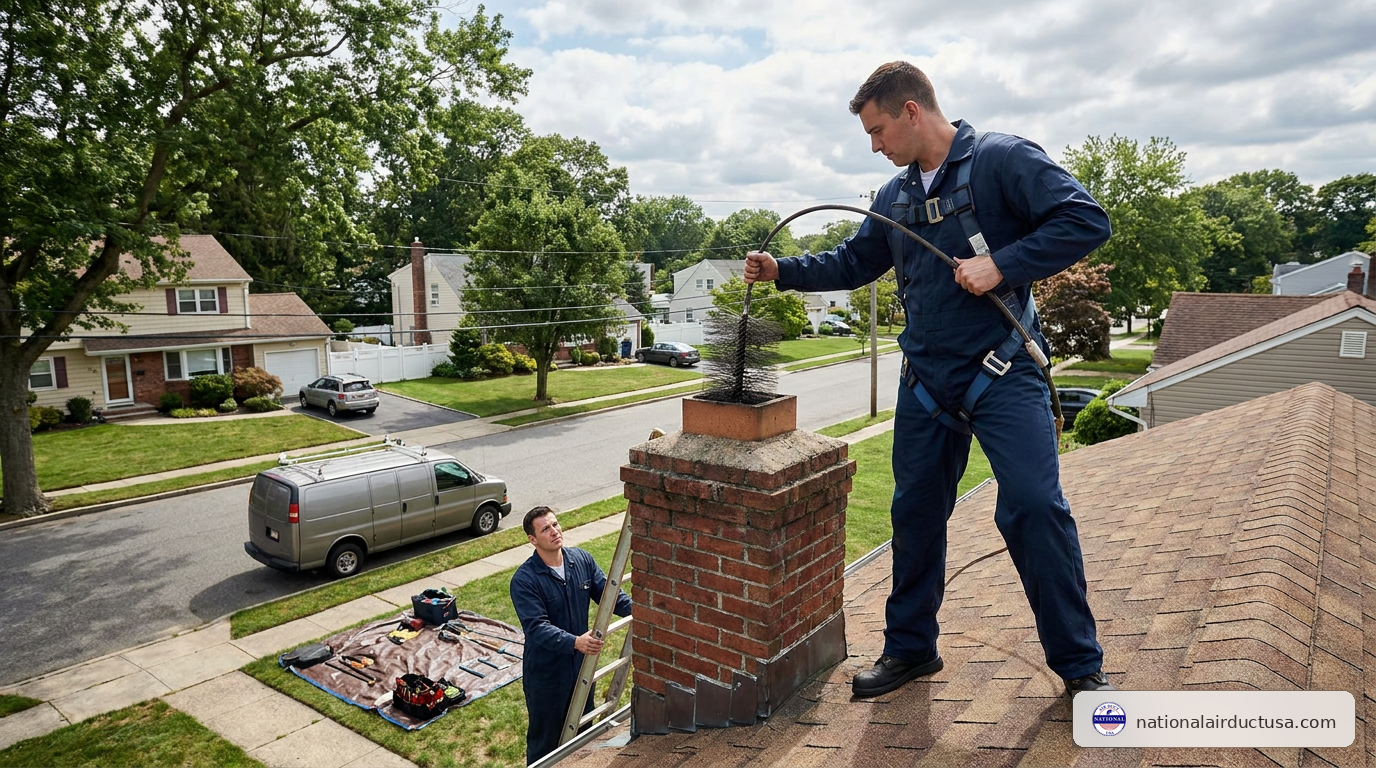
Boiler chimney cleaning in Long Island NY should happen every fall before the heating season starts, and it typically costs $150 to $600 depending on inspection level, fuel type, and flue condition. With roughly 200 New Yorkers hospitalized annually for carbon monoxide poisoning linked largely to fuel-burning appliances, scheduling a combined boiler and chimney service in October is the single best fire-safety and efficiency move homeowners on Long Island’s older housing stock can make right now.
Why October Is the Deadline for Long Island Homeowners
The first real chill has already hit Nassau and Suffolk counties, and furnaces and boilers across Long Island are firing up for the season. That first ignition after months of dormancy is exactly when dormant soot, blocked flues, and deteriorated liners turn into carbon monoxide hazards or reduced heating efficiency. Boiler chimney cleaning in Long Island NY is a seasonal necessity, not an optional luxury, and early October is the narrow window before cold snaps make scheduling a service call harder and before you’re relying on equipment that hasn’t been checked since last spring.
Homeowners from Huntington to Babylon to Dix Hills are discovering the same thing every fall: a boiler that sat idle since April can accumulate soot, rust, and moisture damage in its flue that silently reduces draft and increases carbon monoxide risk. Waiting until the first hard freeze means competing with hundreds of other households for the same limited appointment slots.
What Does Boiler Chimney Cleaning Actually Include?
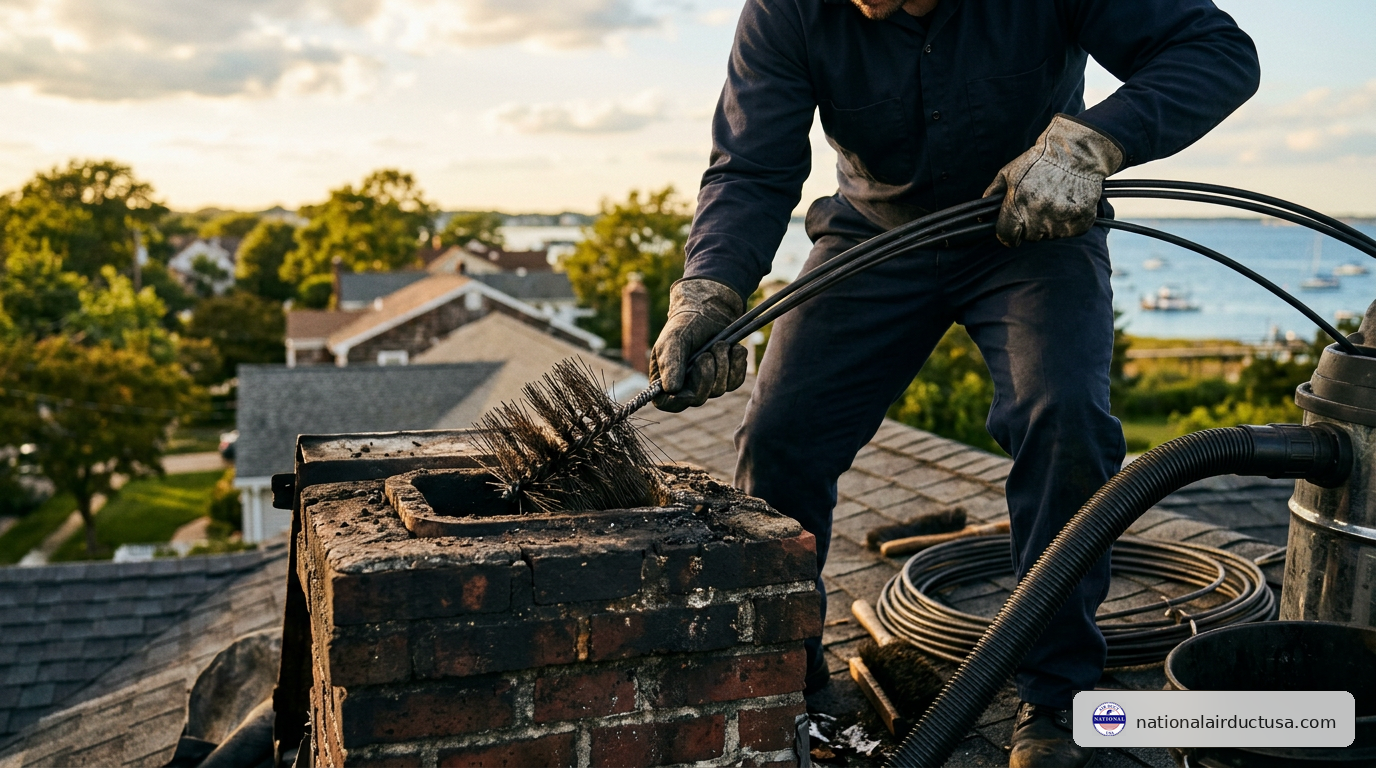
Boiler chimney cleaning is fundamentally a venting and combustion-safety service, not a cosmetic sweep. For the oil- and gas-fired boilers common throughout Long Island’s housing stock, a proper service inspects the flue, removes soot and deposits, checks for blockages or liner deterioration, and confirms that combustion gases are drafting safely outdoors.
- Removing soot and ash from the heat exchanger, flue connector, breeching, smoke pipe, and chimney base
- Inspecting the chimney cap, crown, masonry, flashing, cleanout door, and liner for damage
- Checking for bird nests, leaves, collapsed liner sections, mortar deterioration, and obstructions
- Verifying draft and confirming combustion gases exhaust properly
- For oil equipment, inspecting the burner, nozzle, electrodes, filter, pump pressure, and combustion settings
- Combustion testing, including flue-gas temperature, draft, oxygen/carbon-dioxide readings, and carbon monoxide levels
The Chimney Safety Institute of America recommends a standard three-tier inspection system, and most routine annual service aligns with a Level I masonry chimney inspection, which covers readily accessible portions of the chimney. If your home has had a chimney fire, a fuel change, or is part of a real estate transaction, a more thorough Level II camera inspection is typically warranted. The CSIA’s homeowner resources outline exactly when each level applies.
How Much Does Boiler Chimney Cleaning Cost on Long Island?
Pricing varies based on your specific project, including fuel type, flue access, chimney height, deposit buildup, and current chimney condition. Rather than quoting a single number, it’s more useful to understand the ranges homeowners typically encounter and what drives them higher or lower.
| Service Level | Typical Long Island Range |
|---|---|
| Standard single-flue cleaning | $150 to $350+ |
| Cleaning + Level I inspection bundle | $250 to $420+ |
| Level II camera inspection | $350 to $600+ |
| Additional flue | Varies by provider, often added per flue |
These are market ranges, not fixed government fees, and your actual quote should always be put in writing. Compare that to the cost of boiler replacement on Long Island, which can run into the thousands, and annual maintenance starts to look like one of the cheapest insurance policies a homeowner can buy. For broader context on home service costs in the region, this New York home inspection cost breakdown shows how combustion and venting checks fit into overall home maintenance budgeting.
How Often Should Older Long Island Homes Schedule This Service?
Oil-fired boilers generally need cleaning and service annually, ideally before the heating season, since oil soot accumulates in the heat exchanger and flue in ways that reduce heat transfer and impair draft. Gas-fired boilers should also receive an annual inspection and professional cleaning, even though gas tends to burn cleaner than oil.
Preventative maintenance guidance from Rutgers’ green building preventative maintenance manual emphasizes that mechanical systems, including combustion appliances, perform more efficiently and last longer when serviced on a fixed annual schedule rather than reactively. This mirrors what Long Island HVAC technicians see every October: the homes that get serviced annually rarely have emergency breakdowns in January.
If you’re also managing indoor air quality concerns in the same older home, it’s worth reviewing how often you should clean air ducts in Long Island NY alongside your boiler service, since both systems affect the air circulating through your house.
Why Do Long Island’s Older Homes Need Special Attention?
Long Island’s housing stock skews older than much of the country, with large swaths of homes in communities like Levittown, Massapequa, and Port Washington built in the mid-20th century. These homes frequently still run original or multiple-generation masonry chimneys serving oil or converted gas boilers, and decades of freeze-thaw cycles common to the Northeast climate take a real toll on mortar joints and clay liners.
Research on residential chimney liner deterioration and safety performance documents how cracked or gapped liners allow combustion gases and heat to migrate into adjacent combustible framing, a slow-developing hazard that’s invisible from the exterior. Combine that with coastal humidity from the Atlantic and Long Island Sound, and masonry chimneys here deteriorate faster than in drier inland climates.
Risk factor: mortar joint erosion
Recommended check: Level II scope
Risk factor: oversized flues
Recommended check: Draft and combustion test
Risk factor: condensation corrosion
Recommended check: Annual Level I
What Warning Signs Mean You Need Service Now?
Carbon monoxide poisoning is often silent until it’s severe, which is exactly why combustion safety checks matter more than visible symptoms. New York State data shows approximately 200 people are hospitalized and more than 1,800 visit emergency departments annually because of accidental CO poisoning, with roughly two-thirds of those cases tied to fuel-burning equipment or appliances rather than building fires.
- Soot staining around the boiler’s flue connector or on nearby walls
- A pilot light or burner flame that looks yellow or orange instead of blue
- Rust streaks on the chimney exterior or flaking mortar at the base
- Musty or metallic odors near the boiler room, especially after rain
- Condensation pooling near the chimney base or flue connector
- A chirping carbon monoxide detector, even briefly
Guidance from the University of Nebraska-Lincoln extension on combustion appliance safety reinforces that any one of these signs warrants an immediate professional inspection rather than a wait-and-see approach. If you’re dealing with moisture issues near your HVAC system too, it’s worth reading about why ducts leak water in Long Island NY, since chimney condensation and duct moisture sometimes share a root cause.
How Do You Choose the Right Boiler Chimney Professional?
Not every chimney sweep is qualified to service a boiler’s combustion system, and not every HVAC technician is trained in masonry chimney inspection. Look for a provider who explicitly offers combined packages, since Long Island’s older homes benefit most from a single visit that addresses both the appliance and the venting system together.
- Confirm they perform combustion testing (CO, draft, flue-gas temperature), not just a visual sweep
- Ask whether the quote includes Level I inspection or just basic cleaning
- Request documentation of findings, separate from any recommended repairs
- Verify licensing and insurance, similar to standards outlined in state-level chimney sweep licensing requirements
- Ask if permits are needed for any repair work, referencing resources like boiler permit requirement guidelines
For co-op, condo, or multi-unit buildings, commercial boiler systems carry additional code requirements; New York City’s own design professional boiler project checklist is a useful reference point even for Long Island property managers navigating similar inspection logic. If your property recently underwent renovation work, pairing this service with post-construction deep cleaning services in Long Island NY ensures dust and debris from construction haven’t compounded venting issues.
Key Takeaways
- October is the ideal window to schedule boiler chimney cleaning in Long Island NY before cold weather creates appointment backlogs
- Standard cleaning runs roughly $150 to $350, with inspection bundles and Level II camera checks costing more depending on scope
- New York sees about 200 CO hospitalizations and 1,800+ ER visits annually, with two-thirds tied to fuel-burning appliances
- Oil boilers need annual service; gas boilers benefit from annual inspection too, even with cleaner combustion
- Long Island’s older masonry chimneys face accelerated wear from coastal humidity and freeze-thaw cycles
- Always get combustion testing, not just a visual soot sweep, and request written documentation of findings
- Annual maintenance costs a fraction of boiler replacement, which can run $5,500 to $15,000 or more
People Also Ask
How much does chimney cleaning cost in Long Island, NY?
Standard single-flue cleaning typically costs $150 to $350, while cleaning bundled with a Level I inspection runs $250 to $420. Pricing depends on fuel type, flue height, access, and soot buildup.
Is boiler cleaning different from chimney sweeping?
Yes. Boiler cleaning focuses on the heat exchanger, burner, and combustion settings, while chimney sweeping addresses the flue and masonry structure. A proper service combines both for complete fire safety coverage.
How often should an oil boiler chimney be cleaned?
Oil-fired boilers should generally be cleaned and serviced annually, ideally before the heating season begins in fall. Oil soot accumulates faster than gas residue and can impair draft if left unaddressed.
What is a Level II chimney inspection and when is it needed?
A Level II inspection uses video camera equipment to examine the full interior of the flue and typically costs $350 to $600. It’s recommended after a chimney fire, fuel or appliance change, or during a real estate transaction.
Frequently Asked Questions
What does a boiler chimney cleaning service actually include?+
A complete service removes soot from the heat exchanger and flue, inspects the chimney cap, crown, and liner, checks draft, and performs combustion testing for carbon monoxide and flue-gas temperature. It should address both the appliance and the venting system, not just a cosmetic sweep of the upper chimney.
Why is October the best time to schedule this in Long Island?+
Boilers sit idle through spring and summer, allowing soot and moisture damage to build up in the flue unnoticed. Scheduling service before the first sustained cold snap avoids the scheduling backlog that hits chimney and HVAC companies once temperatures drop.
Are older Long Island homes more at risk for chimney problems?+
Yes. Many Long Island homes built in the mid-20th century still use original masonry chimneys and clay liners, which have endured decades of coastal humidity and freeze-thaw cycles. These conditions accelerate mortar deterioration and liner cracking compared to drier inland climates.
Can a dirty chimney really cause carbon monoxide poisoning?+
Yes. Soot buildup, blocked flues, and liner deterioration can prevent combustion gases from venting properly, pushing carbon monoxide back into the home. New York State records roughly 200 hospitalizations annually linked largely to fuel-burning appliance issues.
Does homeowners insurance require annual chimney inspections?+
Requirements vary by insurer, but many policies expect reasonable maintenance, and documented annual inspections can support a claim if a chimney-related fire or CO incident occurs. Keeping written service records from a licensed provider is a smart practice regardless of your specific policy.
Should I combine chimney cleaning with other home maintenance services?+
Many Long Island homeowners bundle boiler chimney service with related fall maintenance like duct inspections or dryer vent cleaning to address overall home air quality and fire safety at once. Reviewing resources like a dryer vent cleaning guide for Long Island NY can help you plan a full seasonal maintenance checklist.
Don’t wait for the first cold snap to find out your boiler’s chimney has a problem. Explore more home safety and air quality guidance on National Air Duct’s resource library, or contact our team today to schedule a combined boiler and chimney maintenance visit before the Long Island heating season is in full swing. You can also learn more about our approach on our about us page.