Air Duct Cleaning EPA in New York: What Homeowners Really Need to Know
Quick Answer
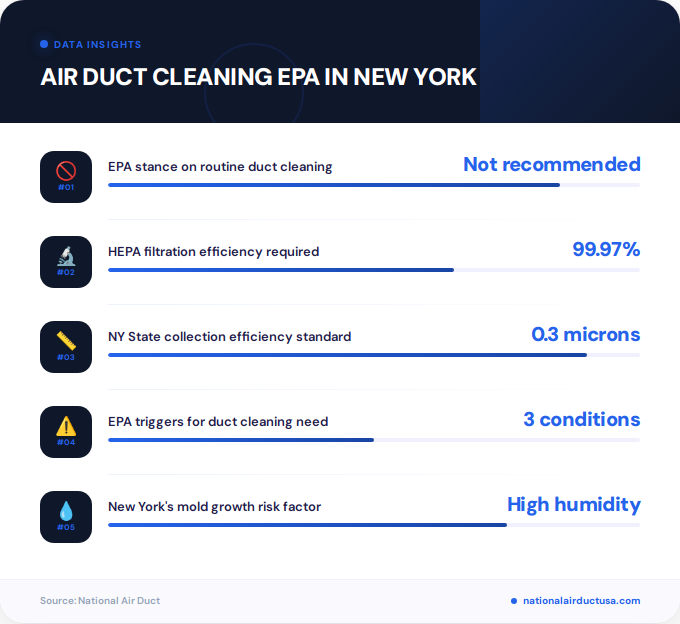
The EPA does not recommend routine, scheduled air duct cleaning for most New York homes. It advises cleaning only when there is visible mold, rodent or insect infestation, or excessive dust and debris actually blowing into rooms from supply registers. New York State procurement specs, when cleaning is warranted, call for HEPA filtration at 99.97% collection efficiency at 0.3 microns and visibly clean ductwork after the job.
Nearly every homeowner in Queens, Long Island, and the greater New York metro area has, at some point, been told they “must” clean their air ducts every year or two. But here’s the surprising truth: the federal agency responsible for indoor air quality guidance does not back that claim. Understanding air duct cleaning EPA in New York standards matters because it separates evidence-based maintenance from sales pressure, and it can save homeowners hundreds of dollars in unnecessary services while still protecting the air quality that matters during humid Long Island summers and dry, heated winters.
What Does the EPA Actually Say About Air Duct Cleaning?
The EPA’s official consumer guidance on residential duct cleaning is clear: routine cleaning is not recommended for the average home. The agency instead lists specific trigger conditions, including substantial visible mold growth on hard-surface ducts or other HVAC components, an infestation of rodents or insects inside the ductwork, and ducts so clogged with dust and debris that particles are visibly discharging into living spaces from supply registers.
This is a condition-based standard, not a calendar-based one. There is no EPA-recommended fixed interval, such as every year or every two years, for cleaning residential ducts. That distinction matters enormously in a market like New York, where duct cleaning sales pitches often imply mandatory annual service.
EPA-aligned technical guidance, referenced in EPA’s technical documentation on indoor air quality management, also stresses that if mold has colonized fibrous insulation inside duct components, the contaminated material typically needs full replacement rather than surface cleaning, since porous insulation can trap spores deep within its structure.
How Does EPA Guidance Apply to New York Homes?
New York’s climate creates specific conditions that can trigger the EPA’s cleaning criteria more often than in drier states. Coastal humidity across Nassau and Suffolk counties, combined with older housing stock in neighborhoods throughout Queens, Brooklyn, and the boroughs, means mold growth in ductwork is a realistic concern, especially in homes with basement HVAC systems or poor moisture control.
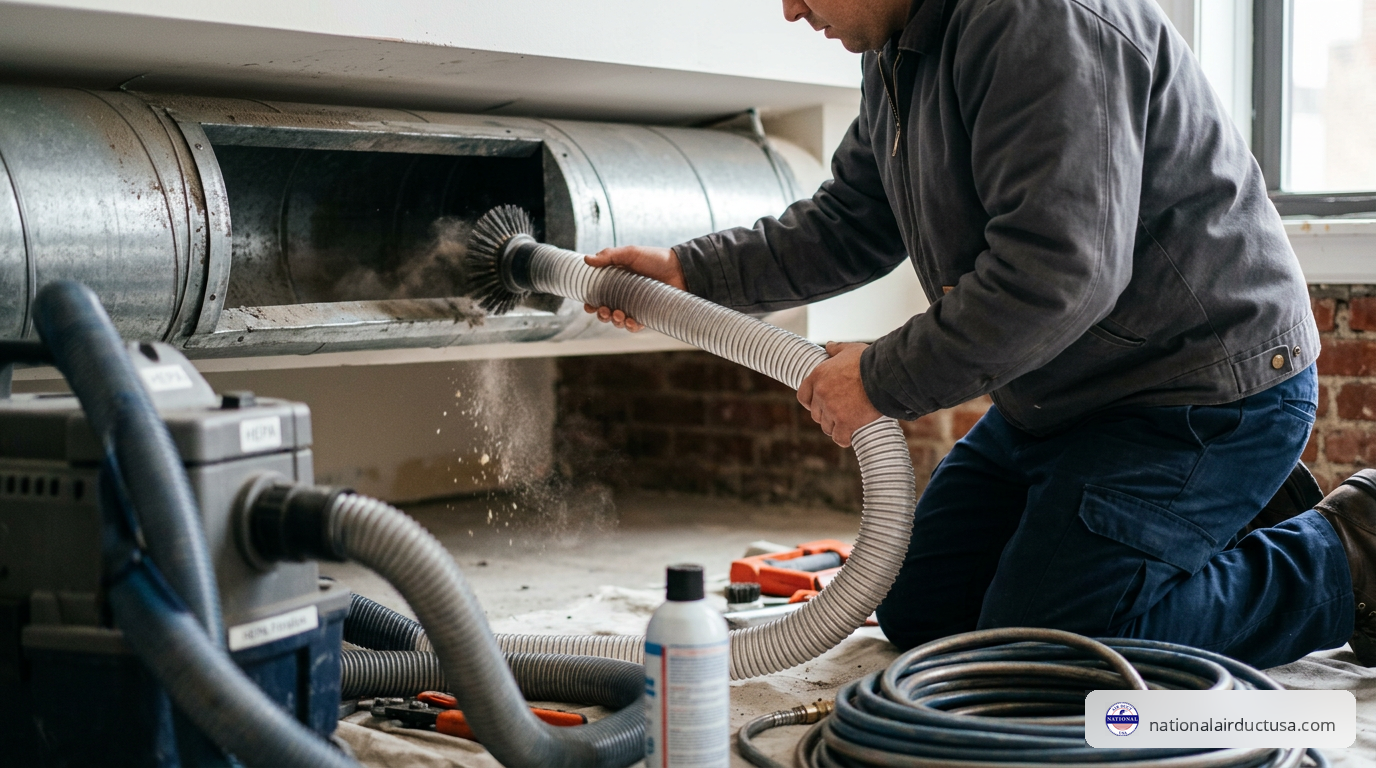
New York State’s own procurement specifications go further than federal consumer guidance when cleaning is actually warranted. The New York State master specification for cleaning air conveyance system components requires mechanical cleaning methods paired with particulate collection equipment, and mandates that ducts and air handling units be left visibly clean, with debris disposed of according to applicable federal, state, and local regulations.
Homeowners researching whether duct cleaning really works in Long Island homes often find that the answer depends heavily on the specific condition of their system, not a one-size-fits-all schedule. This is consistent with what the EPA outlines nationally, applied through a stricter operational lens at the state level.
When Should You Actually Clean Your Air Ducts?
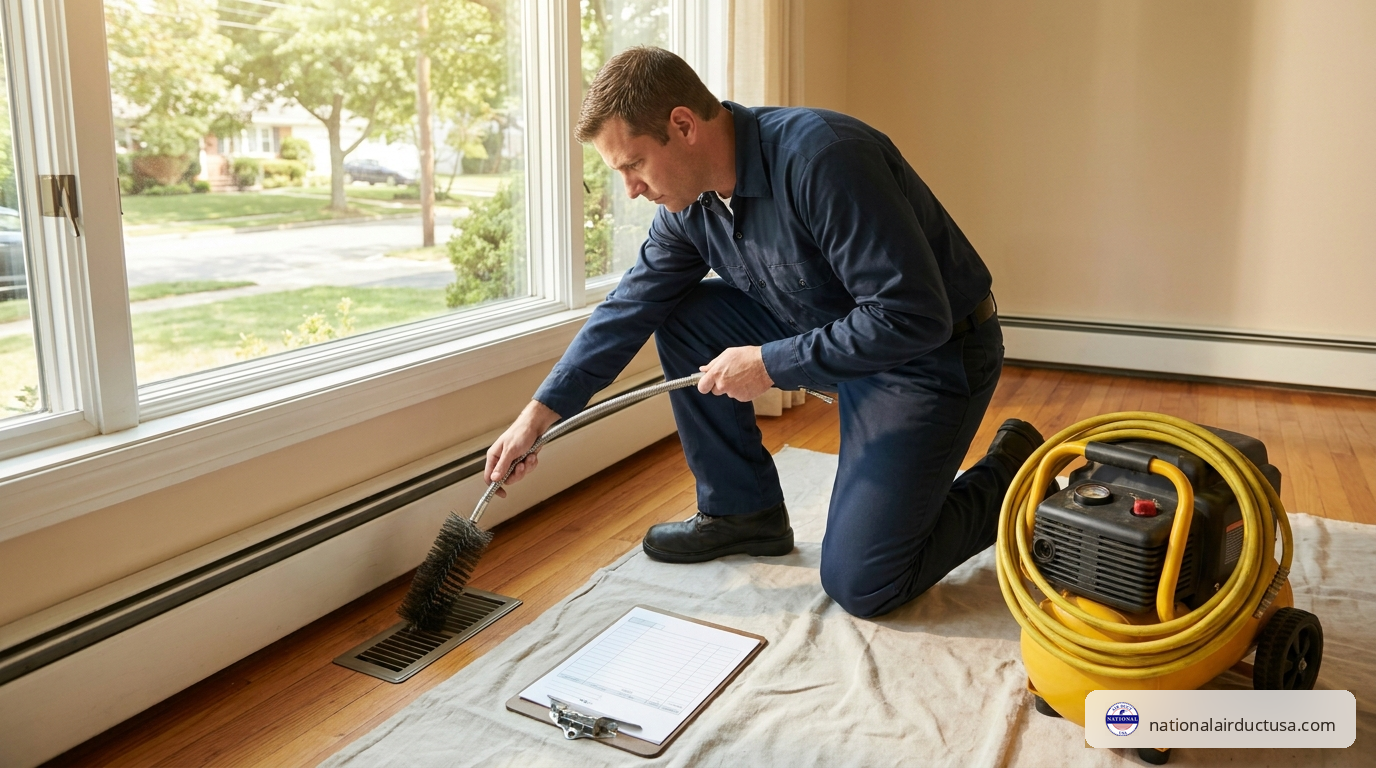
Rather than a fixed timeline, the EPA and aligned industry sources point to observable signs. If you notice any of the following, it is reasonable to have your system professionally assessed:
- Visible mold growth on metal duct surfaces, the interior of the furnace, or the air handler cabinet
- Evidence of rodents or insects, including nests, droppings, or shed insect parts inside ducts
- Dust or debris visibly blowing out of supply registers when the system runs
- Persistent musty odors when the HVAC system cycles on, particularly after flooding or high humidity events
- Recent renovation or construction work that introduced significant dust into the duct system
Industry best-practice guidance, distinct from EPA requirements, often recommends an inspection every 3 to 5 years so a technician can determine whether any of these trigger conditions actually exist. This is inspection, not automatic cleaning. The Trane residential guidance on air duct cleaning benefits similarly frames cleaning as situational rather than a default annual service.
For homeowners unsure what to look for, this New York-specific guide to warning signs your ducts need cleaning offers a practical checklist before you call for service.
What Standards Should a New York Duct Cleaner Follow?
Whether you’re in Westbury, Plainview, Babylon, Smithtown, or Huntington, the technical standard a professional crew should meet doesn’t change. New York State specifications require HEPA filtration with 99.97% collection efficiency at 0.3 microns whenever exhaust air is released indoors during the cleaning process, ensuring contaminants aren’t simply redistributed through the home.
| Standard | Requirement | Source |
|---|---|---|
| Filtration efficiency | 99.97% at 0.3 microns (HEPA) | NY State procurement spec |
| Cleaning trigger | Visible mold, infestation, or debris entering rooms | EPA consumer guidance |
| Fixed schedule | None recommended by EPA | EPA / NADCA guidance |
| Post-job condition | Ducts and units visibly clean | NY State master spec |
NADCA-aligned industry sources reinforce that EPA guidance has long emphasized source control as an indoor air quality best practice, meaning the goal is fixing the actual contamination source, whether that’s a moisture problem, a pest entry point, or a leaky duct joint, rather than simply vacuuming ducts on a recurring basis.
How Much Does Air Duct Cleaning Cost in New York?
Pricing for professional duct cleaning in New York varies significantly, generally ranging from $450 to $3,500+ depending on the size of your home, the number of supply and return vents, system accessibility, whether mold remediation or insulation replacement is needed, and the equipment standards used by the contractor. Homes with basement forced-air systems in Suffolk or Nassau County may cost differently than co-ops or multi-family buildings in Queens with shared HVAC infrastructure.
Because pricing varies based on your specific project, it’s best to request a custom quote after an in-home inspection rather than rely on advertised flat rates. A contractor using true HEPA-filtered equipment and proper containment, as required under New York’s state specifications, may charge more than a low-cost operator using a shop vac, but the difference in indoor air quality outcomes and debris containment can be substantial.
If your ducts were recently exposed to renovation dust, you may also want to review this complete 2026 homeowner checklist for preparing for duct cleaning in New York to understand what a thorough job actually involves before you commit to a quote.
How Do You Choose a Qualified Duct Cleaner in New York?
Not every company advertising duct cleaning in the New York market follows EPA-aligned or NADCA standards. Ask any prospective contractor about their filtration equipment, their approach to visible mold versus routine dust, and whether they’ll document duct condition with photos before recommending service.
Reputable New York providers offering professional air duct cleaning services should be able to explain, in plain terms, why your specific home needs cleaning rather than defaulting to a sales script. Local providers serving Westbury, Plainview, Babylon, Smithtown, and Huntington should be familiar with the region’s humidity-driven mold risks and older housing stock quirks common across Long Island.
Beyond ductwork itself, homeowners with oil or gas heating systems should also consider related maintenance, such as oil furnace chimney cleaning on Long Island or general furnace chimney cleaning throughout New York, since combustion byproducts and duct contamination are often connected issues in older homes.
Schedule: None fixed
Focus: Source control
Outcome: Visibly clean surfaces
Disposal: Regulated debris handling
Basis: NADCA guidance
Not: EPA requirement
For homeowners concerned about allergens rather than mold specifically, it’s worth reviewing evidence on whether air duct cleaning actually removes dust mites in Long Island homes, since expectations here often outpace what cleaning can realistically accomplish. The NIH Division of Occupational Health and Safety fact sheet on HVAC duct cleaning offers additional federal-adjacent context reinforcing that cleaning should be condition-driven rather than routine.
Key Takeaways
- The EPA does not recommend routine or scheduled air duct cleaning for typical New York homes.
- Cleaning is warranted when there’s visible mold, rodent or insect infestation, or debris visibly blowing from vents.
- New York State specifications require HEPA filtration at 99.97% efficiency at 0.3 microns for compliant cleaning jobs.
- There is no EPA-mandated cleaning interval; industry best practice suggests inspection every 3 to 5 years.
- Mold-contaminated fibrous insulation in ducts typically requires replacement, not cleaning.
- Pricing in New York varies widely based on home size, system accessibility, and contamination severity, so always request a custom quote.
- Choose contractors who document conditions with evidence rather than pushing cleaning on a fixed schedule.
People Also Ask
Should you have the air ducts in your home cleaned?
Only if you have visible mold, an infestation, or dust and debris actively blowing into your living space from vents. The EPA does not recommend cleaning as routine maintenance for homes without these specific conditions.
What does the EPA say about air duct cleaning?
The EPA says duct cleaning has not been proven to prevent health problems and should not be done on a routine schedule. It should only be performed when there’s visible mold, pest infestation, or debris release into rooms.
Is air duct cleaning necessary in NYC?
It’s necessary only when specific contamination conditions exist, such as mold, pests, or visible dust release. Given NYC’s older housing stock and humidity swings, inspections every few years are a reasonable precaution, but cleaning itself isn’t automatically required.
How often should air ducts be inspected in New York?
Industry best practice suggests an inspection every 3 to 5 years, though this is not an EPA mandate. Homes with basement HVAC systems, pets, or recent renovations may benefit from more frequent checks.
Frequently Asked Questions
Does the EPA require air duct cleaning?+
No. The EPA does not require or even generally recommend air duct cleaning unless there is visible mold, infestation, or debris entering the home. It’s guidance, not a mandate, and applies the same way in New York as anywhere else in the country.
What filtration standard should New York duct cleaners use?+
New York State procurement specifications call for HEPA filtration with 99.97% collection efficiency at 0.3 microns whenever exhaust air is released indoors during cleaning. This prevents contaminants from being redistributed throughout the home.
Can mold in air ducts be cleaned instead of replaced?+
If mold has grown inside porous, fibrous insulation within duct components, it generally needs to be replaced rather than cleaned, since spores can embed deep in the material. Mold on hard, non-porous metal surfaces can typically be cleaned and disinfected.
How much does air duct cleaning cost in New York?+
Costs generally range from $450 to $3,500 or more depending on home size, system accessibility, contamination severity, and whether mold remediation is involved. Pricing varies based on your specific project, so a custom quote after an in-home inspection is recommended.
What signs indicate my New York home’s air ducts need cleaning?+
Visible mold on metal ductwork, signs of rodents or insects, dust visibly blowing from vents, and musty odors after humid weather are the main indicators. Recent renovation dust is another common trigger for cleaning.
Is duct cleaning covered by NADCA standards in New York?+
NADCA sets industry best-practice standards for source control and cleaning methods, though it is not a government regulatory body. New York State’s own procurement specifications add enforceable technical requirements for state-contracted work, including HEPA filtration benchmarks.
If you’re unsure whether your New York home actually meets the EPA’s trigger conditions for cleaning, the safest step is a professional inspection rather than guesswork. Visit National Air Duct’s homepage to learn more about evidence-based duct services, review our about us page for our approach to indoor air quality, or contact our team today for a no-pressure assessment and custom quote tailored to your home’s specific condition.
Further reading: How to Improve Indoor Air Quality at Home in New York: The Complete 2026 Guide