Quick Answer
The fastest way to improve indoor air quality in Long Island NY is to measure pollutant levels, control sources like gas stoves and moisture, upgrade your HVAC filter to MERV 11-13, and have your air ducts professionally cleaned since Long Island’s older housing stock (median home age around 65 years) traps decades of dust, allergens, and wildfire smoke residue inside ductwork. Combine clean ducts with a properly sized portable air cleaner and tighter moisture control for the biggest measurable improvement.
Why Does Indoor Air Quality Matter So Much on Long Island?
Here’s a number that surprises most homeowners: the New York-Newark metropolitan area ranked 12th worst in the nation for ozone pollution in the 2026 American Lung Association “State of the Air” report, earning an outright F grade for ozone exposure. That report also found year-round particle pollution improved to a passing grade, while short-term particle spikes still earned a D. If you’ve wondered how to improve indoor air quality in Long Island NY, that F grade is exactly why the question matters: when outdoor air struggles, your indoor air inherits the problem unless you actively manage it.
Long Island’s air quality challenge is twofold. Outdoor ozone and wildfire smoke drift in from the west and from Canadian wildfires, while indoor sources, older housing stock, combustion appliances, and poor ventilation compound the problem once that air gets trapped inside. On September 10, 2026, Long Island’s observed AQI registered 35 for ozone, a “Good” reading, but that number has swung wildly throughout the year. During the July 2026 Canadian wildfire smoke event, AQI readings exceeded 100 in parts of Long Island, a level the EPA classifies as unhealthy for sensitive groups.
Residents noticed. News coverage from that period described the sky over Suffolk and Nassau counties as eerie and hazy during the air quality alert, and towns like Southampton saw repeated advisories. In fact, Long Island received another air quality alert tied to Canadian wildfire smoke just weeks after the first. These aren’t rare, one-off events anymore; they’re becoming a seasonal pattern homeowners need a plan for.
What’s Actually in Long Island’s Indoor Air?
Indoor air quality on Long Island is shaped by a mix of outdoor intrusion and indoor generation. Understanding the sources helps you prioritize fixes instead of guessing.
- Outdoor ozone and wildfire smoke: Fine particulate matter (PM2.5) is small enough to penetrate deep into lung tissue and can enter homes through open windows, door gaps, bathroom fans, and HVAC intakes.
- Older housing stock: A 2026 statewide analysis put New York’s median home age at roughly 65 years, which correlates with dust reservoirs in ductwork, unsealed basements, deteriorated materials, and combustion backdrafting.
- Combustion appliances: Statewide data shows approximately 62% gas-stove use, a major indoor source of nitrogen dioxide and fine particles, especially in homes without range hoods vented outdoors.
- Radon: Long Island’s geology makes radon testing essential, particularly in homes with basements or crawl spaces.
- Moisture and mold: Long Island’s humid summers and coastal proximity create conditions for condensation, damp basements, and mold growth in ducts and wall cavities.
- Heating demand: New York averages roughly 3,352 heating degree days per year, meaning homes stay sealed up tight for months, recirculating whatever is already indoors.
New York State’s Department of Environmental Conservation has repeatedly issued fine-particle advisories covering Long Island, warning that indoor PM2.5 can remain elevated even after outdoor air clears if homes have indoor sources like tobacco smoke, candles, or cooking fumes. That’s a critical point: closing your windows during a smoke event doesn’t guarantee clean air if your own habits are adding pollutants indoors.
How Do You Measure Indoor Air Quality Before Fixing It?
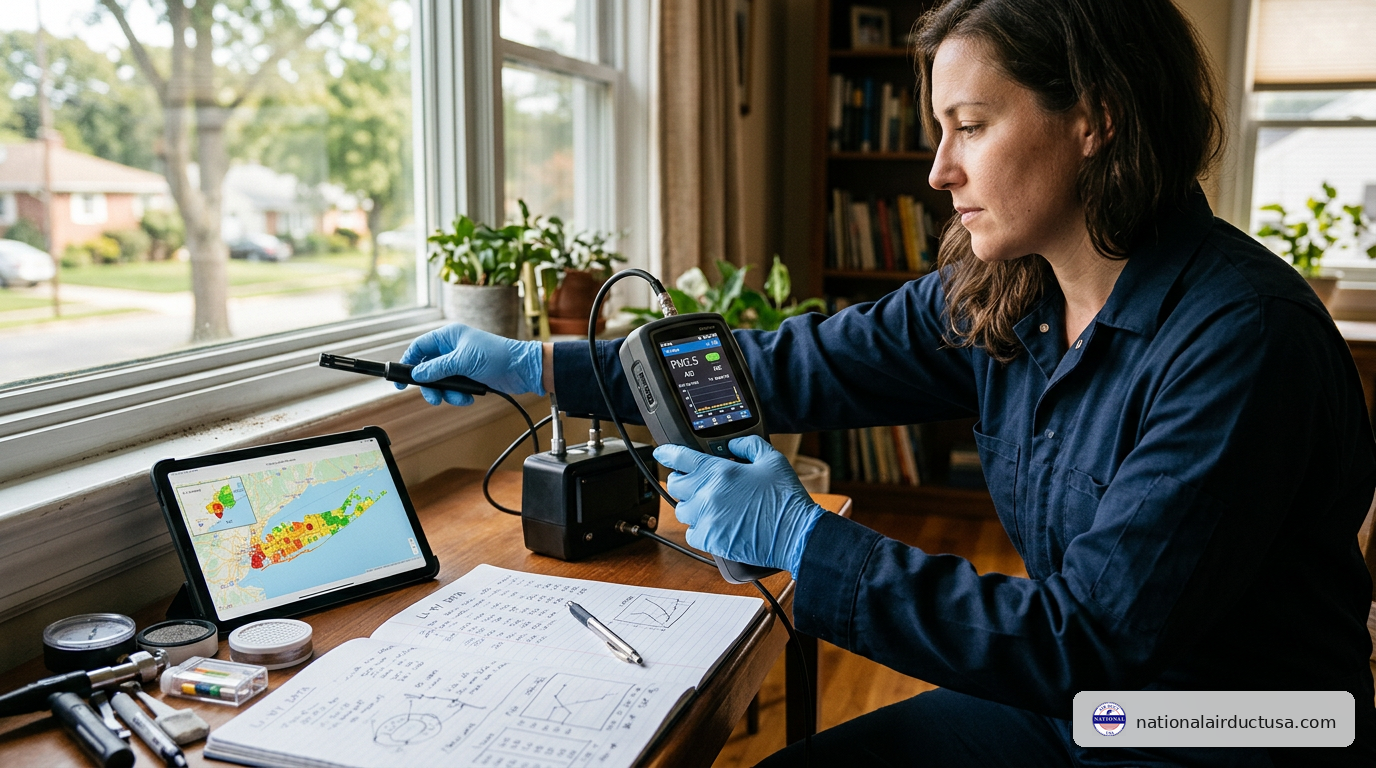
You can’t manage what you don’t measure. Before buying an air purifier or upgrading your HVAC filter, establish a baseline.
- Check regional AQI data. The New York State DEC’s real-time AQI tracker shows current ozone and particulate readings for Long Island and surrounding regions, updated throughout the day.
- Test for radon. A simple home radon test kit, or a professional test, is the only reliable way to know if this invisible gas is present in your basement or living space.
- Use an indoor air monitor. Consumer-grade PM2.5 and CO2 monitors cost relatively little and give you real-time feedback on whether your indoor strategies are actually working.
- Inspect your ductwork visually. Dust buildup around vent covers, musty odors when the HVAC kicks on, or visible debris are strong indicators that your duct system needs professional attention. Our guide on signs you need air duct cleaning walks through what to look for.
For a Long Island-specific breakdown of current conditions and what they mean for your household, see our dedicated resource on Long Island air quality, which tracks regional trends alongside practical homeowner guidance.
Why Is Duct Cleaning the Cornerstone of Air Quality Strategy?
Your HVAC system is the lungs of your house. Air circulates through the same ductwork dozens of times a day, and in a region with a median home age around 65 years, that ductwork has often never been professionally cleaned.
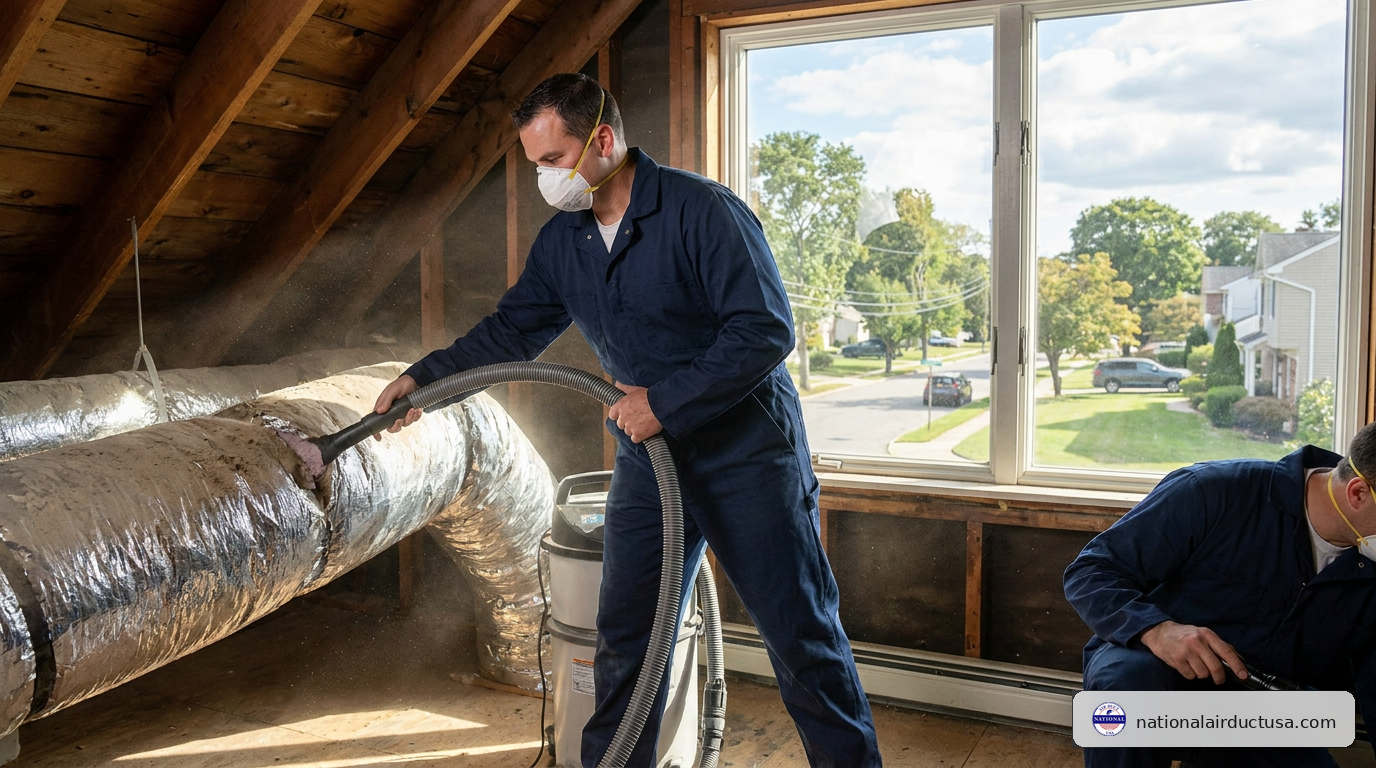
Dust, pollen, pet dander, and even wildfire smoke particulates settle inside duct runs over time. Every time your system cycles on, it redistributes that buildup throughout the home. This is especially relevant after a smoke event: particles pulled in through HVAC intakes during a wildfire advisory don’t just disappear when the air clears outside, they often settle into ductwork and get recirculated for weeks or months afterward.
“On Long Island, we see homes where the ductwork hasn’t been touched in over a decade. After a summer of wildfire smoke advisories, that system has been pulling in and redistributing fine particulates the entire time. Clean ducts don’t eliminate every indoor air problem, but they remove a major reservoir of pollutants that keeps re-contaminating the air you just filtered.”
Duct cleaning matters most for homes that fall into a few categories: older construction, recent renovation or demolition work, visible mold or moisture in the ductwork, pet owners, allergy or asthma sufferers, and anyone who lived through the 2026 wildfire smoke events with windows occasionally cracked. If your home checks any of these boxes, it’s worth reading our guide on air duct cleaning and mold removal in New York, which explains how mold and duct contamination interact.
It’s also worth understanding the health connection directly. Our article on whether dirty air ducts can make you sick breaks down the research linking contaminated ductwork to respiratory symptoms, which is particularly relevant for Long Island households already managing ozone and particulate exposure from outside.
What Role Do Filters and Ventilation Play?
Duct cleaning removes existing buildup, but filtration and ventilation determine what gets added going forward. Think of it as a two-part system: clean the reservoir, then control the inflow.
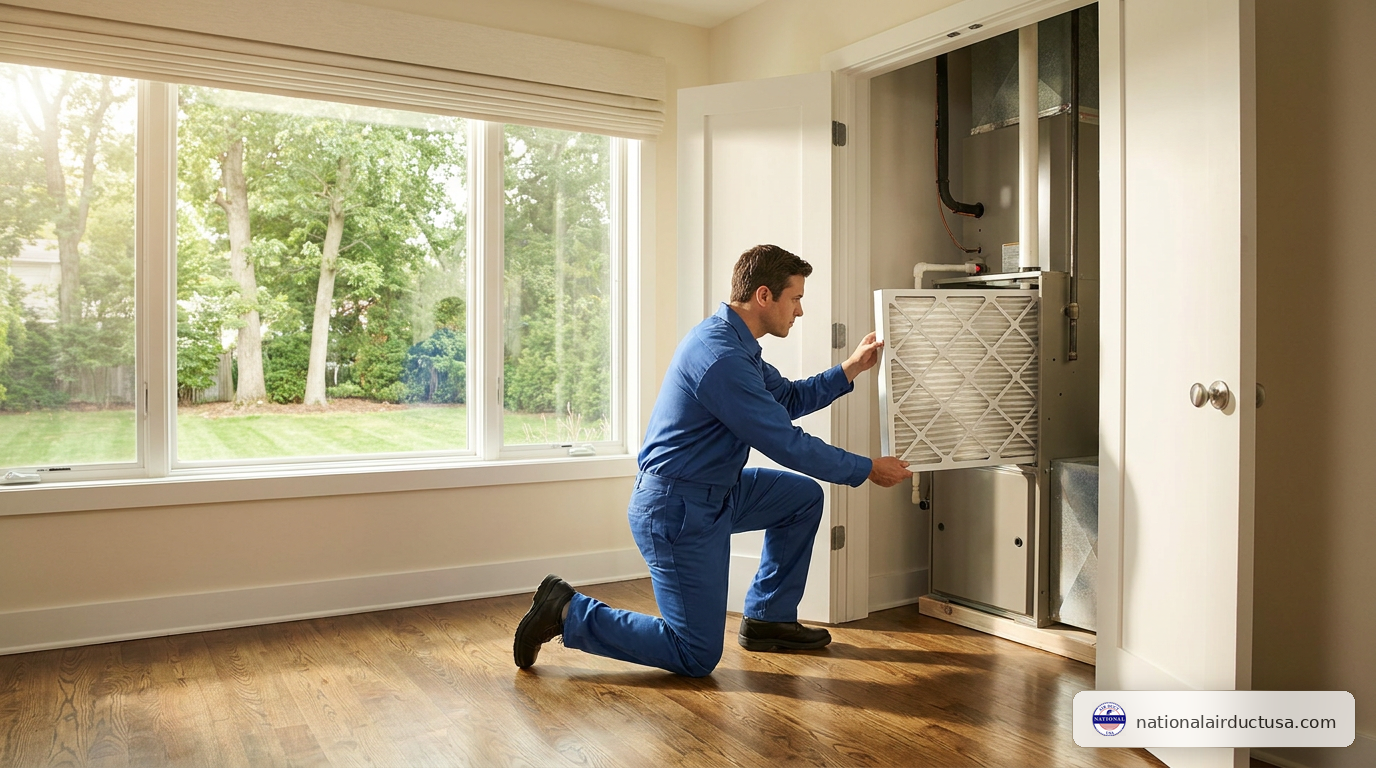
- Upgrade to MERV 11-13 filters if your HVAC equipment can handle the added static pressure. Higher MERV ratings capture finer particles, including much of the PM2.5 load from wildfire smoke, but always confirm your system’s capacity first.
- Run HVAC fans in recirculate mode during smoke advisories rather than pulling in fresh outdoor air.
- Use a properly sized portable air cleaner with a true HEPA filter in bedrooms or main living areas, especially during ozone-health advisories.
- Avoid ozone-generating air cleaners. Despite marketing claims, these devices produce ozone, itself a lung irritant and a known contributor to the very pollution category Long Island already struggles with.
- Ventilate strategically. Bathroom and kitchen exhaust fans should vent outdoors, not into attics or crawl spaces, to prevent moisture and combustion byproducts from accumulating.
The NYSERDA indoor air quality program also notes that energy efficiency upgrades, like sealing and insulation, can inadvertently tighten a home and trap pollutants if ventilation isn’t addressed at the same time. This is a common issue in Long Island’s older housing stock, where retrofits sometimes outpace ventilation planning.
If your HVAC system itself is overdue for a tune-up, a full HVAC system maintenance checklist ensures filters, coils, and airflow are all working together rather than against each other.
How Does Moisture Control Prevent Mold on Long Island?
Long Island’s coastal humidity, combined with aging basements and crawl spaces, creates near-ideal conditions for mold growth. Mold spores circulated through ductwork are a frequent, often overlooked contributor to poor indoor air quality.
Keep indoor relative humidity between 30% and 50%. Use dehumidifiers in basements, especially during humid summer stretches, and address any roof leaks, foundation cracks, or plumbing leaks promptly. The NYC Department of Health’s indoor air quality guidance emphasizes that moisture control is one of the single most effective, low-cost interventions available to homeowners, because mold cannot grow without sustained moisture.
Dryer vents are another overlooked moisture and lint source. A clogged dryer vent traps humid air and lint inside your home’s structure, raising both fire risk and mold potential. Our dryer vent cleaning guide for Long Island homeowners covers how often this maintenance task should happen.
How Do the Main Air Quality Fixes Compare?
Not every intervention delivers the same impact for the same effort. Here’s how the core strategies stack up.
| Strategy | Primary Benefit | Frequency |
|---|---|---|
| Professional duct cleaning | Removes dust, allergen, and smoke-residue reservoirs | Every 2-3 years, or after renovations |
| HVAC filter upgrade (MERV 11-13) | Captures fine particles going forward | Every 1-3 months |
| Portable HEPA air cleaner | Targeted room-level filtration during smoke events | Run continuously during advisories |
| Dehumidification | Prevents mold growth conditions | Seasonal, especially summer |
| Radon testing | Identifies a serious, invisible health hazard | Every 2 years |
What’s a Realistic Action Plan for Long Island Homeowners?
Improving indoor air quality doesn’t require doing everything at once. A sequenced approach produces better, measurable results.
- Measure first. Check the DEC’s AQI tool, test for radon, and consider a low-cost indoor air monitor.
- Inspect and clean your ductwork. If it’s been more than two to three years, or you’ve never had it done, this is the foundational step. See our guide on how often you should clean air ducts in Long Island NY for a personalized timeline.
- Upgrade filtration appropriately for your HVAC system’s capacity.
- Control moisture with dehumidifiers and prompt leak repairs.
- Eliminate avoidable indoor sources like smoking indoors, unvented candles, and idle gas burners.
- Stay alert during advisories. Follow New York State’s guidance, including the steps outlined by Governor Hochul’s statewide air quality safety guidance, during wildfire smoke or ozone events.
- Schedule recurring maintenance rather than treating air quality as a one-time fix.
Pricing for professional duct cleaning and related indoor air quality services varies widely, generally ranging from $300 to $1,500+ depending on home size, duct configuration, level of contamination, and whether mold remediation or dryer vent work is included. Larger homes, multi-zone HVAC systems, and homes with documented mold growth typically fall toward the higher end. We recommend a custom quote based on an in-home or virtual assessment rather than relying on a flat estimate, since every Long Island home’s ductwork and air handling setup is different.
National rank: 12th worst
2026 grade: F
Gas stove use: ~62%
Heating degree days: ~3,352
Classification: Unhealthy for sensitive groups
Source: Canadian wildfires
Key Takeaways
- Long Island’s metro area earned an F grade for ozone in the 2026 American Lung Association report, ranking 12th worst nationally.
- Wildfire smoke pushed AQI above 100 in parts of Long Island during July 2026, triggering multiple state advisories.
- New York’s median home age of roughly 65 years means many homes have ductwork that’s never been professionally cleaned.
- Measuring air quality first, through AQI tools, radon tests, and indoor monitors, prevents wasted effort on the wrong fixes.
- Duct cleaning removes the pollutant reservoir that keeps recirculating dust, allergens, and smoke residue long after outdoor air clears.
- MERV 11-13 filters, HEPA portable air cleaners, and humidity control between 30-50% round out an effective layered strategy.
- Avoid ozone-generating air cleaners; they add to the pollution problem rather than solving it.
People Also Ask
Does duct cleaning actually improve indoor air quality?
Yes, when ducts are visibly contaminated with dust, mold, or debris, professional cleaning removes a major source of recirculating pollutants. It works best as part of a broader strategy that also includes filtration upgrades and moisture control.
What is causing bad air quality on Long Island right now?
Ozone pollution and periodic Canadian wildfire smoke are the main outdoor drivers, while older housing, gas stoves, and inadequate ventilation contribute to indoor pollution. The combination explains why Long Island saw both a passing AQI day (35 on September 10, 2026) and smoke-driven spikes above 100 just months earlier.
How often should I check air quality advisories in New York?
During summer months, especially June through August, it’s worth checking daily during active wildfire or ozone advisory periods. The New York State DEC’s AQI tracker updates throughout the day and is the most reliable local source.
Can an air purifier replace duct cleaning?
No. A portable air purifier filters air in the room where it’s placed, but it doesn’t remove dust and debris already built up inside your ductwork, which gets redistributed throughout the house every time the HVAC system runs. The two serve different, complementary purposes.
Is radon a concern in Long Island homes?
Yes, radon can be present in homes across Long Island depending on local geology, particularly in basements and lower levels. Testing every two years is a low-cost way to rule out this invisible, odorless health risk.
Frequently Asked Questions
How do I know if my Long Island home needs duct cleaning?+
Common signs include visible dust around vents, musty odors when the HVAC runs, increased allergy symptoms indoors, and a home that hasn’t had its ducts cleaned in more than two to three years. Our guide to signs your air ducts need cleaning covers the full checklist.
What should I do during a wildfire smoke advisory on Long Island?+
Keep windows and doors closed, run your HVAC in recirculate mode with a high-rated filter, use a portable HEPA air cleaner, and avoid indoor combustion sources like candles or frying. Check the DEC’s AQI tracker before deciding to ventilate.
How much does professional duct cleaning cost on Long Island?+
Pricing typically ranges from $300 to $1,500 or more, depending on home size, duct configuration, contamination level, and whether mold remediation is needed. Because every home differs, a custom quote based on an assessment is the most accurate way to budget.
What MERV rating should I use for my HVAC filter?+
MERV 11 to 13 filters capture fine particles effectively, including much of the PM2.5 from wildfire smoke, but not every HVAC system can handle the added airflow resistance. Check your system’s specifications or consult an HVAC technician before upgrading.
Does dryer vent buildup affect indoor air quality?+
Yes, a clogged dryer vent traps lint and moisture, which can contribute to indoor humidity problems and mold risk, in addition to being a fire hazard. Regular cleaning, detailed in our dryer vent maintenance guide, helps prevent both issues.
How often should Long Island homeowners get their ducts cleaned?+
Most homes benefit from professional duct cleaning every two to three years, though homes with pets, recent renovations, or visible mold may need it more frequently. A professional inspection can confirm the right timeline for your specific system.
Related: Signs of Mold in Air Ducts: What Long Island NY Homeowners Must Know
Improving indoor air quality in Long Island NY isn’t a single purchase or a one-time fix, it’s a layered strategy built on measurement, source control, filtration, and regular maintenance. Given the region’s F-grade ozone ranking, periodic wildfire smoke events, and aging housing stock, the ductwork carrying air through your home deserves the same attention as the filters and purifiers sitting on top of it. If it’s been years since your system was professionally cleaned, now is the time to address it before the next advisory hits. National Air Duct offers assessments across Nassau and Suffolk counties, and you can reach out for a custom quote or learn more about our approach to indoor air quality before scheduling service.