Quick Answer
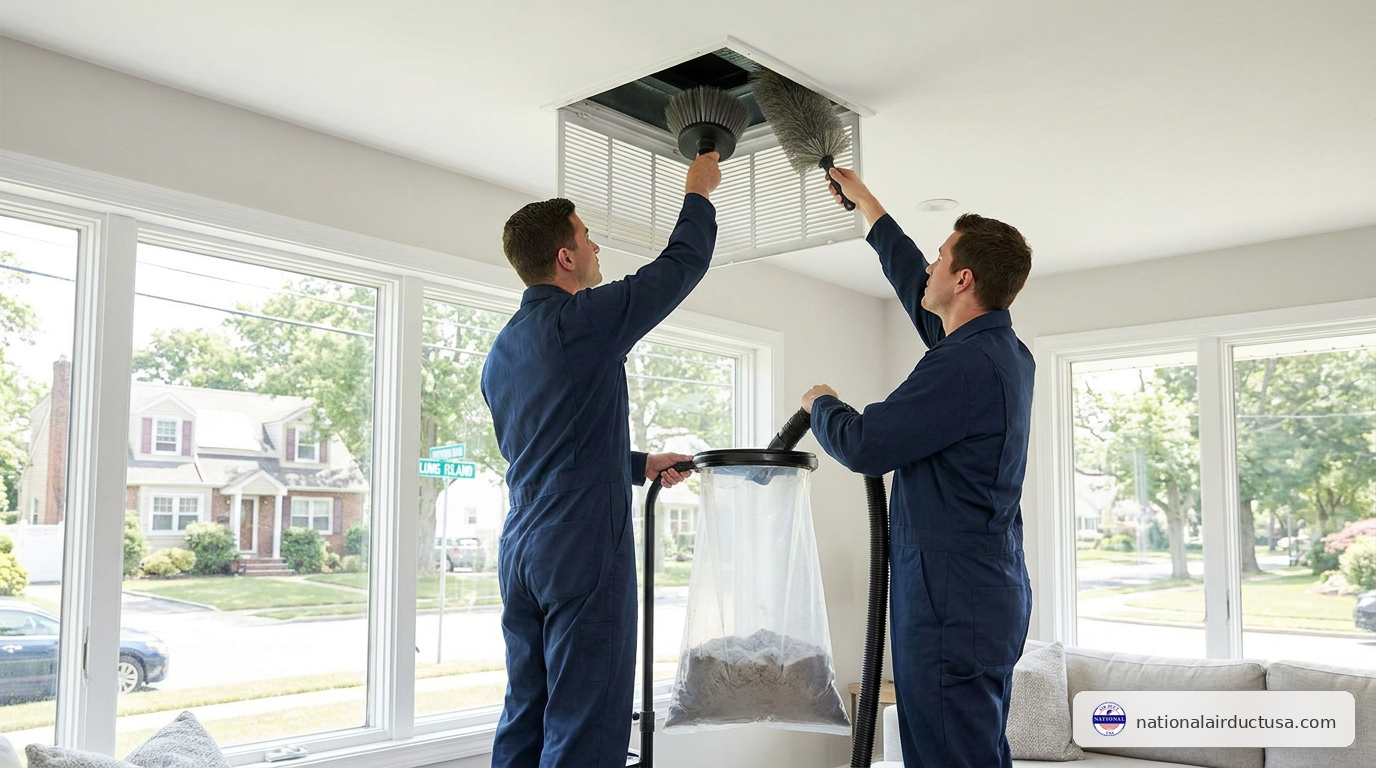
Air duct cleaning removes dust and debris that has built up inside ductwork, but research from the EPA and independent studies shows it does not reliably reduce the dust that settles on furniture and floors in Long Island, NY homes. Duct cleaning is most valuable when there is visible mold, pest contamination, heavy construction debris, or dust visibly blowing from registers, not as a routine fix for everyday household dust.
Why Does Dust Accumulate in Long Island Ductwork?
Every forced-air HVAC system acts like a slow-moving funnel for airborne particles. As air circulates through supply and return ducts, dust, pollen, pet dander, and fine debris settle on interior duct surfaces the same way they settle on a windowsill. Over years of operation, this creates visible buildup, especially in homes across Nassau and Suffolk counties where seasonal pollen and coastal humidity add extra particulate load.
Older Long Island homes, particularly those built before the 1990s in communities like Levittown, Massapequa, and Huntington, often have ductwork with leaky joints, uninsulated seams, or sections running through dusty crawlspaces and attics. These gaps pull in unconditioned attic or crawlspace air loaded with insulation fibers, rodent debris, and construction dust, which then deposits inside the duct runs.
Understanding this accumulation process matters because it explains why duct interiors can look dramatically dirty even when a home’s everyday dust levels seem normal. The dirt is often adhered to the metal or fiberboard surfaces rather than being actively released into living spaces, which is a key distinction in the research discussed next.
What Does the Research Actually Show About Duct Cleaning and Dust?
This is the central question behind does air duct cleaning reduce dust in Long Island NY, and the data is more nuanced than most marketing suggests. The EPA’s guidance on residential duct cleaning states plainly that dirt in ducts often adheres to surfaces and does not necessarily enter occupied rooms, and that studies have not conclusively shown dirty ducts increase household particle levels.
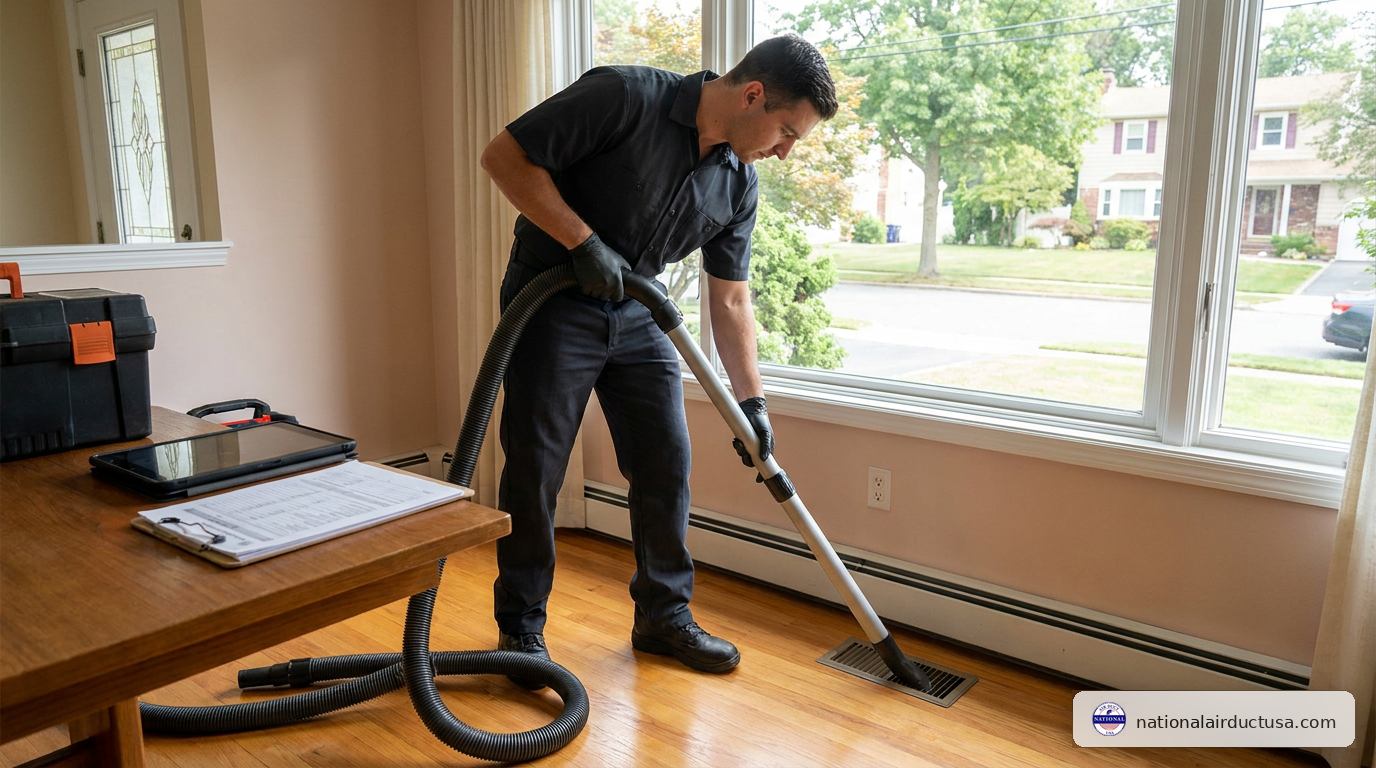
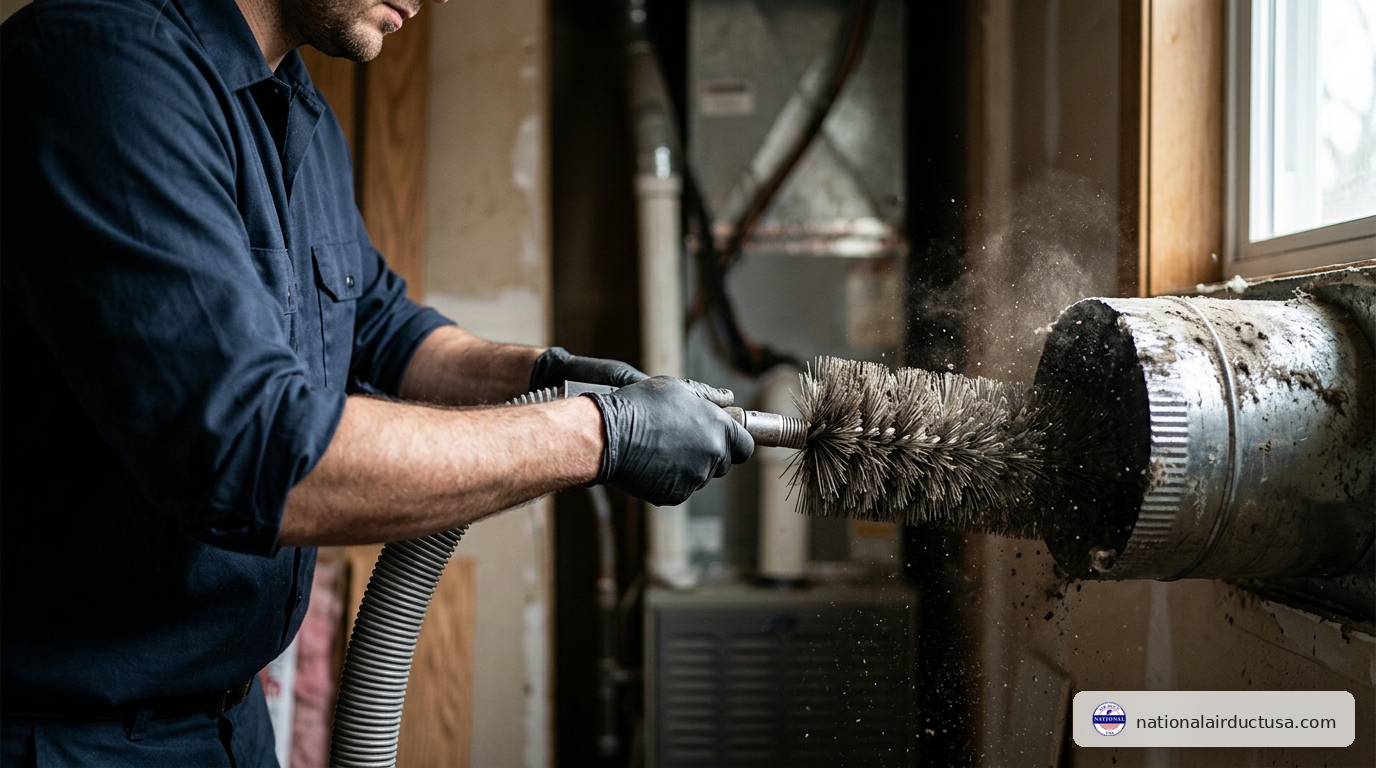
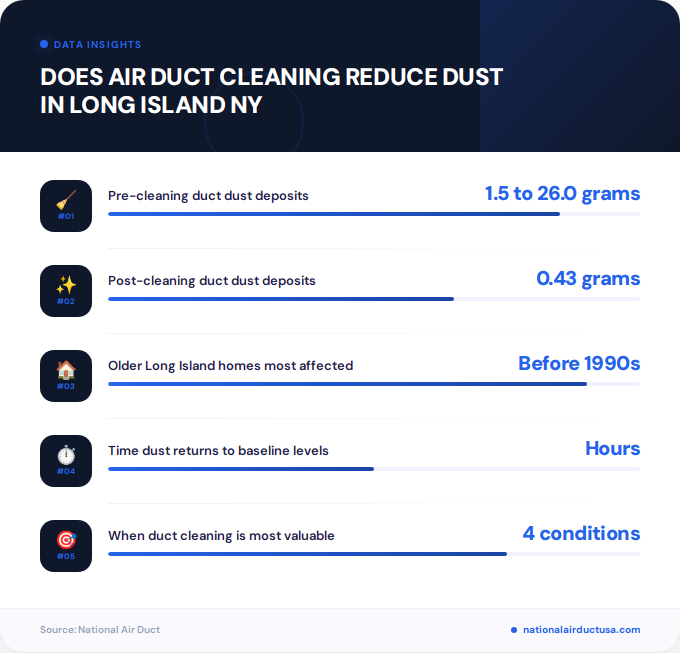
An EPA-supported field study, documented in a technical EPA field report on duct cleaning effectiveness, measured dust deposits before and after professional source-removal cleaning. Pre-cleaning deposits averaged approximately 1.5 to 26.0 grams per square meter, while post-cleaning deposits dropped to about 0.43 grams per square meter. That is a dramatic reduction inside the ducts themselves.
However, the same study found that indoor airborne dust concentrations were not substantially different after cleaning. A related EPA technical memorandum, referenced in archived EPA indoor air quality documentation, reported that household dust concentrations briefly rose immediately after cleaning, then returned to baseline within hours. Peer-reviewed research cataloged on PubMed’s review of duct cleaning health outcomes reached similar conclusions about limited sustained benefit for airborne particle levels.
Does Cleaning Ducts Reduce Household Dust or Just Duct Dust?
This distinction is the crux of the issue for homeowners from Garden City to Bay Shore. Cleaning removes dust from the ducts very effectively. It does not reliably reduce the dust that lands on your coffee table, TV screen, or hardwood floors, because most household dust originates from sources other than the ductwork itself: skin cells, fabric fibers, tracked-in soil, and outdoor particles entering through doors and windows.
| Question | Evidence-Based Answer |
|---|---|
| Does cleaning remove dust from ducts? | Yes, when ducts contain meaningful deposits and the contractor uses proper source-removal methods. |
| Does it reduce visible household dust? | Not reliably demonstrated in controlled studies. |
| Does it improve respiratory health? | The EPA states this has not been shown. |
| Does it improve HVAC energy efficiency? | Not reliably demonstrated when cleaning is performed alone, without sealing or filter upgrades. |
| Should every home be cleaned on a fixed schedule? | No. The EPA recommends cleaning based on visible need, not a calendar schedule. |
This doesn’t mean duct cleaning is worthless. It means homeowners should set realistic expectations. For a full breakdown of how the process works locally, our Long Island air duct cleaning guide walks through what a proper source-removal service actually includes.
When Does Duct Cleaning Actually Make a Measurable Difference?
Duct cleaning earns its keep in specific, identifiable situations rather than as a blanket dust-prevention routine. Independent research compiled by Canada’s national research agency in a government-backed duct cleaning effectiveness study similarly found that cleaning benefits were concentrated in homes with specific contamination issues rather than general dust complaints.
- Visible mold growth inside ducts or on coils, especially common after Long Island’s humid summers
- Rodent or pest infestation evidenced by droppings, nesting material, or odors from vents
- Post-renovation debris from drywall dust, sawdust, or insulation disturbed during remodeling
- Visible dust or debris physically blowing from supply registers when the system runs
- Recent home purchase where duct history and condition are unknown
If your project involved recent remodeling, see our detailed answers on air duct cleaning after construction in Long Island NY. And if you’re simply trying to figure out whether your home qualifies for a cleaning visit, our guide on signs your air ducts need cleaning covers the visual and odor-based indicators worth watching for.
How Do Long Island’s Climate and Housing Stock Affect Dust Levels?
Long Island’s dust profile is shaped by several regional factors that don’t necessarily change the duct-cleaning math, but do affect overall household dust load. Coastal humidity swings between summer and winter create condensation inside ductwork, which can combine with dust to form sticky residue rather than loose particles that redistribute easily.
Seasonal pollen from oak, maple, and ragweed blankets the region each spring and fall, entering homes through open windows, HVAC intake, and foot traffic. Many Long Island neighborhoods also sit near major roadways (the LIE, Northern State, and Southern State corridors), which contribute vehicle exhaust particulates that settle indoors regardless of duct condition. You can review regional particulate trends on our Long Island air quality resource page.
Homes in older sections of Hempstead, Babylon, and Smithtown frequently have ductwork that’s 20 to 40 years old, often uninsulated or poorly sealed. That age and condition matter more for dust control than the simple act of cleaning, because leaky ducts continuously pull in new contaminants even after a cleaning service finishes.
Post-cleaning average: 0.43 g/m²
Source: EPA field study
Short-term spike: Yes, then returns to baseline
Pest contamination: Yes
Construction debris: Yes
Routine mild dust: Limited value
What Reduces Household Dust More Effectively Than Duct Cleaning Alone?
If the goal is genuinely less dust on surfaces throughout a Long Island home, several interventions have stronger evidence behind them than duct cleaning performed in isolation. These strategies address the actual pathways dust uses to enter and circulate through living spaces.
- Seal duct leaks at joints, boots, and plenums to stop unconditioned attic or crawlspace air from entering the system
- Replace filters on the correct schedule and upgrade to a higher MERV-rated filter compatible with your system’s airflow capacity
- Control outdoor-air infiltration by weatherstripping doors and windows, especially during high-pollen months
- Improve vacuuming habits using HEPA-filtered vacuums and frequent attention to carpets, rugs, and upholstery
- Manage indoor humidity between 30 and 50 percent to reduce dust mite populations and mold-friendly conditions
- Maintain the HVAC system overall, including coil cleaning and blower maintenance, not just duct interiors
Trade publications echo this layered approach. Coverage from industry analysis on whether ductwork cleaning really works emphasizes that duct cleaning performs best as one piece of a broader indoor air quality plan rather than a standalone fix. NADCA, the trade association for the industry, makes a similar point in its own discussion of scientific credibility within the duct cleaning industry, arguing that proper certification and process matter more than cleaning frequency alone.
For homeowners managing a whole-home approach, pairing duct service with a dryer vent inspection is worth considering, since lint buildup is a separate but related fire and air-quality concern covered in our dryer duct cleaning Long Island service page.
What Determines the Cost of Duct Cleaning in Long Island?
Pricing for professional duct cleaning varies considerably based on home size, number of vents and return lines, duct accessibility, current condition, and whether additional services like sanitizing, mold remediation, or dryer vent work are bundled in. Homes with attic-run ductwork, crawlspace sections, or evidence of pest activity typically require more labor and specialized equipment than a straightforward single-story ranch.
Rather than quoting a flat number, it’s more accurate to say pricing varies based on your specific project, and a reputable contractor should provide a full inspection before offering an estimate. Our cost breakdown for Long Island duct cleaning walks through the variables in detail, and our homeowner checklist for getting an accurate estimate helps you prepare questions before a technician arrives.
Homeowners in Nassau County specifically can review localized process and outcome expectations in our Nassau County duct cleaning process and results guide.
Key Takeaways
- Duct cleaning effectively removes deposits from inside ductwork but has not been shown to reliably reduce household airborne or settling dust.
- The EPA states that dirty ducts have not been conclusively linked to higher indoor particle levels or health problems.
- An EPA field study measured deposit reductions from roughly 1.5-26.0 g/m² down to 0.43 g/m², yet indoor dust levels remained largely unchanged afterward.
- The strongest justifications for cleaning are visible mold, pest contamination, heavy construction debris, or dust visibly blowing from registers.
- Sealing leaks, upgrading filters, managing humidity, and consistent vacuuming are more proven strategies for reducing everyday household dust.
- Long Island’s older housing stock, coastal humidity, and seasonal pollen all contribute to dust, independent of duct condition alone.
- Duct cleaning should be scheduled based on visible need and inspection findings, not a fixed calendar interval.
People Also Ask
Is air duct cleaning worth it for reducing dust?
It’s worth it when ducts contain visible mold, pests, or heavy construction debris, but research shows it’s not a reliable fix for routine household dust. Combining it with filter upgrades and leak sealing produces better overall results.
How often should Long Island homeowners clean their air ducts?
The EPA recommends cleaning based on visible need rather than a fixed schedule. Our guide on how often to clean air ducts in Long Island NY breaks down specific triggers to watch for.
Does dust come back after duct cleaning?
Studies found indoor dust levels briefly rose right after cleaning, then returned to pre-cleaning baseline within hours, since most household dust originates outside the ducts. This is why duct cleaning alone rarely changes everyday dust levels on furniture.
What is the real cause of excessive dust in a house?
Most household dust comes from skin cells, fabric fibers, tracked-in soil, and outdoor particles entering through doors and windows, not from the ductwork itself. Leaky ducts can add to the problem, but sealing and filtration changes typically matter more than cleaning alone.
Frequently Asked Questions
Does air duct cleaning reduce dust in Long Island NY homes?+
It reduces dust accumulated inside the ductwork itself but has not been shown to reliably reduce household dust settling on furniture or floors. The EPA and independent studies found indoor airborne dust levels remain largely unchanged after cleaning.
What does the EPA say about duct cleaning and dust?+
The EPA states that dirt in ducts often adheres to surfaces rather than entering occupied rooms, and that duct cleaning has not been shown to prevent health problems. They recommend cleaning based on visible need rather than routine schedules.
When is duct cleaning actually necessary in Long Island?+
Cleaning is best justified by visible mold, pest infestation, heavy post-renovation debris, or dust visibly blowing from supply registers. Routine cleaning for mild dust alone shows limited benefit in controlled research.
What’s a better strategy than duct cleaning for reducing dust?+
Sealing duct leaks, upgrading and replacing filters on schedule, managing indoor humidity, and consistent HEPA vacuuming have stronger evidence for reducing everyday household dust than duct cleaning alone.
How much does duct cleaning cost on Long Island?+
Cost depends on home size, duct accessibility, condition, and any added services like mold remediation or dryer vent cleaning. A technician should inspect your system first and provide a custom written quote rather than a flat rate.
Can duct cleaning improve HVAC energy efficiency?+
Cleaning ducts alone has not been reliably shown to improve energy efficiency. Sealing leaks and maintaining the full HVAC system, including coils and blower components, tends to have a bigger impact.
Should I find a duct cleaning company near me in Long Island?+
Working with a local, certified provider ensures they understand the region’s housing stock, humidity patterns, and seasonal pollen issues. Our guide to finding duct cleaning services near you in Long Island covers what to check before booking.
Understanding the real science behind duct cleaning helps you make a smarter decision for your home rather than relying on marketing claims. If your ducts show visible contamination, pest activity, or post-renovation debris, professional air duct cleaning services can make a meaningful difference. Homeowners in Westbury and surrounding communities can learn more about localized service details on our Westbury NY air duct cleaning page, and anyone preparing for an appointment should review our step-by-step preparation guide beforehand.
Ready to find out whether your Long Island home’s ductwork actually needs professional attention? Visit National Air Duct USA or reach out through our contact page for a thorough inspection and a custom, no-pressure quote based on your home’s actual condition.