Quick Answer
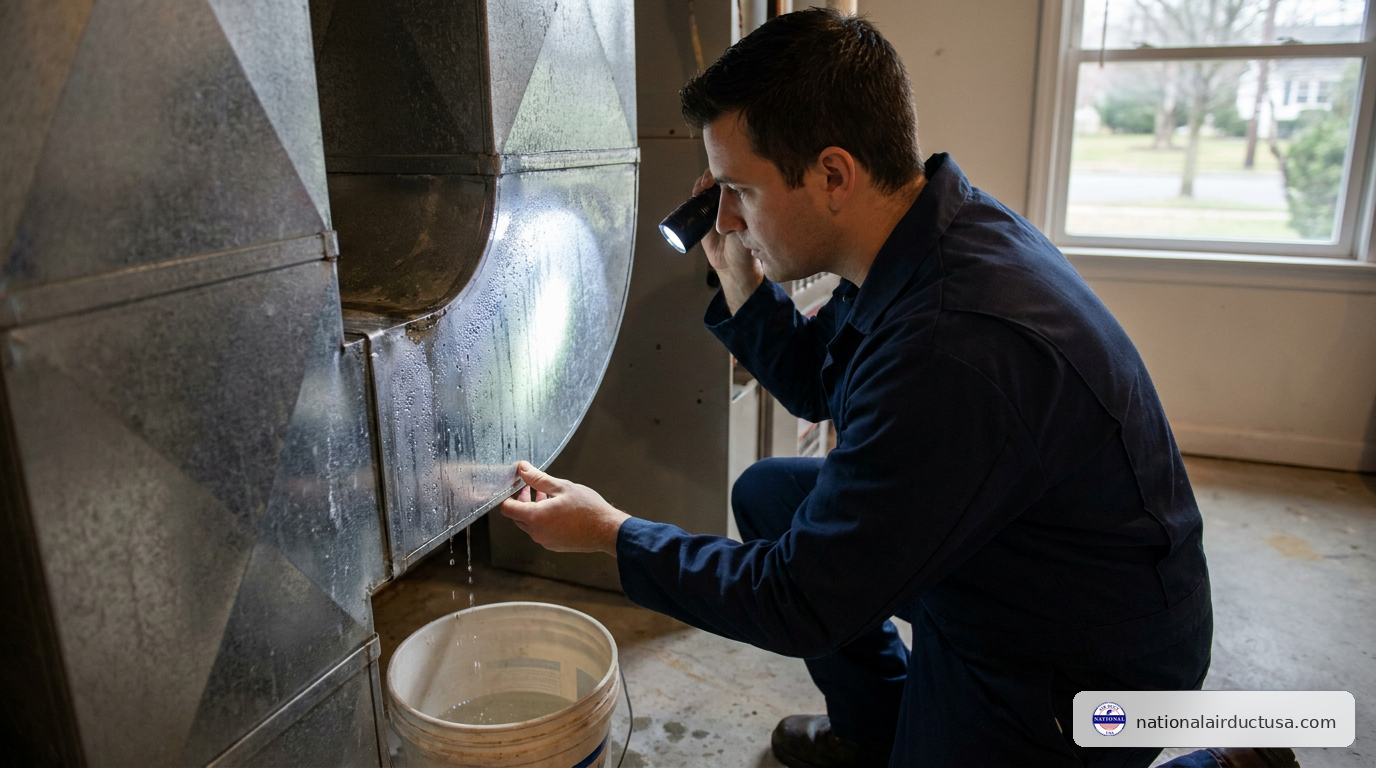
Duct leaking water in Long Island NY homes is almost always caused by condensation, a clogged condensate drain, a frozen evaporator coil, or missing duct insulation rather than a defective duct itself. Long Island’s humid summers, older housing stock, and attics or crawlspaces full of ductwork make condensation control especially critical. The fix depends on diagnosis: it could be a simple drain-line flush or a larger insulation and sealing upgrade.
You walk into the basement or attic and find a wet stain spreading across drywall, a puddle under the air handler, or rusty water dripping from a supply duct. It’s unsettling, and it’s also one of the most common HVAC complaints across Nassau and Suffolk counties every summer. Duct leaking water in Long Island NY homes is rarely about a cracked duct; it’s almost always a symptom of trapped humidity meeting a cold surface, or a drainage system that’s quietly failed. Understanding which problem you have determines whether the fix costs a service call or a full system overhaul.
There’s no single public database tracking how many Long Island homes report water-leaking ducts each year. Most of these cases are handled privately by HVAC technicians and never show up in municipal records. What we do have is a clear technical picture from New York’s own building and energy codes, which spell out exactly how ducts should be insulated and sealed to prevent this problem in the first place.
Why Are Ducts Leaking Water on Long Island Right Now?
Long Island’s coastal humidity is the core driver. When cold air-conditioned supply ducts run through a hot, moisture-laden attic, crawlspace, or soffit, water vapor in the surrounding air condenses on the duct’s outer surface the moment it meets a surface below the dew point. This is simple physics, not a manufacturing flaw, and it’s explained well in this breakdown of why ductwork sweats in humid conditions.
Homes in older neighborhoods from Levittown to Babylon to Huntington often have ductwork that was installed decades before current insulation standards existed. Add an unfinished attic, a damp crawlspace, or an unconditioned basement mechanical closet, and you have the exact combination that produces chronic condensation. The Building Science Corporation’s research on ventilation in hot, humid climates confirms that uninsulated or poorly sealed ducts in these spaces are a near-guaranteed source of moisture problems.
What Are the Most Common Causes of Water Leaking From Ducts?
Before calling a contractor, it helps to know what’s typically behind the puddle. Here are the four leading culprits technicians see across Long Island service calls.
1. Condensation on Uninsulated or Under-Insulated Ducts
This is the classic summer problem. Cold supply air inside the duct chills the metal or flex-duct exterior below the surrounding air’s dew point, and moisture beads up and drips. It’s especially common in attics above Garden City, Massapequa, and other communities with older, uninsulated duct runs.
2. Clogged Condensate Drain Line
Your air conditioner pulls humidity out of indoor air at the evaporator coil, and that water is supposed to flow through a condensate drain line to the outside or a floor drain. Algae, dust, and sediment build up over time and block the line, causing water to back up into the drain pan and overflow onto the floor or ceiling below.
3. Frozen Evaporator Coil
Restricted airflow (often from a dirty filter or dirty ductwork) or low refrigerant charge can cause the coil to ice over. When the system cycles off and the ice melts, it releases more water than the drain pan and line were built to handle, resulting in overflow.
4. Roof, Plumbing, or Attic Leaks Mistaken for Duct Leaks
Sometimes the duct isn’t leaking at all. Water tracks along a duct run from a roof leak, a failed plumbing vent stack, or an attic HVAC unit’s own overflow pan, and pools lower down, making it look like the duct itself is the source.
How Do You Diagnose a Leaking Duct Yourself?
A few basic checks can narrow down the cause before a technician even arrives.
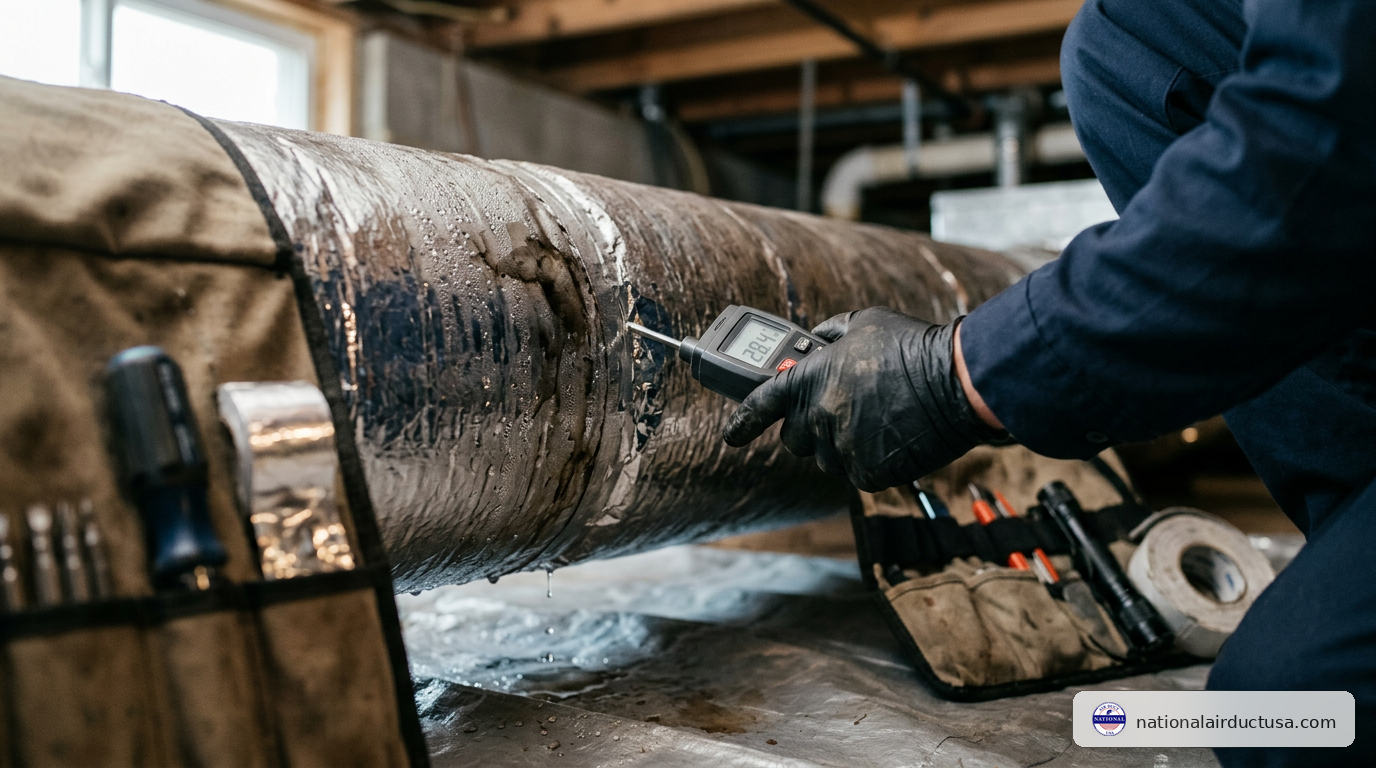
- Touch test: Is the duct’s exterior cold and wet to the touch, or is the water pooling below it without the duct itself being damp? Cold and wet points to condensation; dry duct with water nearby points to a drain or plumbing issue.
- Check the drain pan: Look at the primary and secondary drain pans near your air handler. Rust, standing water, or algae buildup signals a clogged condensate line.
- Inspect the filter: A filthy, clogged filter restricts airflow and is a leading cause of frozen coils. If airflow feels weak at the vents, this could be your answer.
- Look for a pattern: Does the leak only happen on the hottest, most humid days? That strongly suggests condensation rather than a structural leak.
- Trace the water’s path: Follow stains upward. If they lead toward the roofline rather than a duct joint, you may have a roofing issue, not an HVAC one.
If dirty ducts or a musty smell are part of the picture, it’s worth reading about how dirty air ducts can affect your family’s health, since chronic moisture and debris often go hand in hand.
What Red Flags Mean You Need Emergency Repair?
Not every drip is an emergency, but some situations call for immediate action rather than a scheduled visit.
- Water is actively dripping onto electrical components, wiring, or near an electrical panel.
- Ceiling drywall is sagging, bubbling, or showing a growing water stain.
- You smell a musty or moldy odor near the duct or air handler, which can indicate mold has already started growing.
- The system’s emergency float switch has shut the unit down (this is a safety feature designed to prevent overflow damage, and it means the drain is already blocked).
- Water has been present for more than 24 to 48 hours, since mold can begin colonizing damp materials within that window.
If you’re seeing visible mold growth, the issue has likely moved beyond a simple drain clog. Our complete guide to air duct cleaning and mold removal in New York covers what remediation actually involves and when it’s necessary.
What Are Your Repair Options and Trade-Offs?
Once the cause is identified, homeowners generally face one of the following paths. Each comes with different costs, disruption levels, and long-term reliability.
| Repair Option | Best For | Trade-Offs |
|---|---|---|
| Drain line flush/clear | Clogged condensate line, active overflow | Fast and affordable, but will recur without regular maintenance |
| Duct insulation upgrade | Chronic summer condensation on duct exteriors | More labor-intensive, but solves the root cause for years |
| Duct sealing and vapor retarder | Leaky joints plus condensation together | Addresses two problems at once but requires code-compliant materials |
| Coil/refrigerant repair | Frozen evaporator coil causing overflow | Requires licensed HVAC technician and refrigerant handling |
| Whole-system re-ducting | Severely deteriorated, uninsulated, or undersized ductwork | Highest upfront cost but eliminates recurring issues long term |
New York’s mechanical code is specific about what proper duct protection looks like. Cooling ducts running through unconditioned spaces must be insulated with a vapor retarder rated at no more than 0.05 perm, or wrapped in aluminum foil at least 2 mils thick, unless a qualifying spray foam system is used, according to the NYC mechanical code guidance on duct systems. The 2025 New York energy code builds on this by generally requiring at least R-6 insulation for ducts in unconditioned spaces and R-8 for ducts outside the building envelope in our climate zone, as outlined in the 2025 Energy Conservation Construction Code of New York State.
How Much Does It Cost to Fix a Leaking Duct?
Pricing varies widely depending on the root cause, the accessibility of your ductwork, the materials used, and the extent of any water damage that needs repair alongside the HVAC fix. A simple condensate drain clearing sits at the lower end of the spectrum, while a full insulation retrofit or re-ducting project in a hard-to-access attic or crawlspace can run considerably higher.
Typical range: $150 to $600+
Typical range: $800 to $4,000+
Typical range: $300 to $2,500+
Typical range: $3,000 to $15,000+
These are broad ranges because pricing varies based on your specific project, including attic versus crawlspace access, duct material, the quality of insulation specified, and whether water damage repair or mold remediation needs to happen first. A premium, code-compliant repair done once by an experienced crew typically costs more upfront than a quick patch, but it avoids the repeat service calls and drywall damage that come from treating symptoms instead of causes. Always request a written, itemized quote and treat rock-bottom bids with skepticism, since they often skip insulation thickness or sealing steps required by code.
What Questions Should You Ask a Contractor?
A thorough technician should be able to answer these clearly, not vaguely.
- What specifically is causing the water, and how did you confirm it (not just guess)?
- Will the insulation and vapor retarder you’re installing meet current New York code requirements?
- Is this a permanent fix, or a temporary patch that buys time?
- Will you test the duct system for leakage, and what standard are you testing against?
- Do you also check the ducts for existing mold or debris buildup while you’re in there?
- What’s included in the written estimate, and what could add to the final cost?
- Do you offer any warranty on labor and materials?
Reputable New York contractors reference actual code language rather than vague promises. For example, duct leakage testing in certain new-construction contexts must meet no more than 4 cubic feet per minute per 100 square feet of conditioned floor area, a benchmark detailed in NYSERDA’s design professionals manual on energy code compliance. If a contractor can’t speak to standards like this, keep shopping.
How Can You Prevent This From Happening Again?
Prevention is cheaper than repeat repairs, especially heading into another humid Long Island summer.
- Schedule annual HVAC maintenance that includes condensate line flushing before peak cooling season.
- Replace air filters every 1 to 3 months to protect airflow and prevent coil freezing.
- Have ductwork in attics, crawlspaces, and basements inspected for proper insulation thickness and sealed joints.
- Keep gutters and roof flashing in good repair so roof leaks don’t get mistaken for duct problems.
- Consider a professional cleaning if you haven’t had one in a few years. Check our guide on how often you should clean air ducts in Long Island NY for a realistic schedule.
- Improve whole-home humidity control, since drier indoor air reduces condensation risk on cold duct surfaces, a concept explored further in our indoor air quality guide for Long Island homes.
Homeowners managing multiple moisture-prone systems, like PTAC units in older co-ops and condos along the North Shore, should also review our PTAC unit maintenance guide for Long Island NY, since clogged drains are a nearly identical issue in those systems.
People Also Ask
Can leaking ducts cause mold?
Yes. Standing water or chronic condensation inside ductwork or on insulation creates ideal conditions for mold within 24 to 48 hours. Left unaddressed, mold can spread into drywall, insulation, and HVAC components.
Is it safe to run my AC if ducts are leaking water?
It’s generally safer to shut the system off until the source is identified, especially if water is near electrical components. Running it longer can worsen water damage and increase mold risk.
Why does this happen more in summer on Long Island?
Long Island’s coastal humidity peaks in summer, and cold supply ducts running through hot attics or crawlspaces are far more likely to hit the dew point and sweat. This is why condensation-related calls spike during the hottest, most humid stretches of the season.
How do I know if it’s condensation versus a real leak?
Condensation typically appears as a thin film of moisture across the duct’s entire exterior surface, worsening on hot, humid days. A true leak tends to show a concentrated drip point, often at a joint or seam, regardless of outdoor humidity.
Frequently Asked Questions
What causes duct leaking water in Long Island NY homes most often?+
The leading causes are condensation on uninsulated ducts in hot attics or crawlspaces, clogged condensate drain lines, frozen evaporator coils, and occasionally roof or plumbing leaks that mimic a duct problem. A technician needs to trace the water’s actual source before any repair begins.
How much does fixing a leaking duct cost on Long Island?+
Costs range broadly depending on the cause, from a few hundred dollars for a drain line flush to several thousand for insulation retrofits or full re-ducting. Pricing varies based on your specific project, so it’s best to get a custom quote after a proper diagnosis.
Does New York code require duct insulation?+
Yes. New York’s energy and mechanical codes require ducts in unconditioned spaces to carry a vapor retarder and specific minimum R-values, generally R-6 for unconditioned interior spaces and R-8 outside the building envelope in our climate zone. Ducts inside conditioned living space may not require additional insulation.
How quickly should I address a water leak near my ducts?+
Treat it as urgent if water is near electrical equipment, drywall is sagging, or a musty smell is present, since mold can begin growing within 24 to 48 hours. For slow, minor condensation, you still want it addressed within days to avoid structural or mold damage.
Can a dirty air duct system contribute to this problem?+
Yes, indirectly. Heavy dust and debris buildup can restrict airflow, contributing to coil freezing and subsequent condensate overflow, and existing moisture can accelerate mold growth inside dirty ducts. Reviewing signs you need air duct cleaning can help you catch both issues together.
Should I hire a plumber or an HVAC technician for this issue?+
Start with an HVAC technician, since most duct water issues trace back to condensation, insulation, or the condensate drain system tied to your cooling equipment. A plumber becomes necessary only if diagnosis points to an actual plumbing line or roof drainage issue.
Can I prevent this before next summer?+
Yes. Annual maintenance that includes condensate line flushing, filter replacement, and a duct insulation inspection catches most issues before peak humidity hits. Booking this in spring, before Long Island’s hottest and most humid months, is the most effective timing.
Related: Signs of Mold in Air Ducts: What Long Island NY Homeowners Must Know
Related: Air Duct Cleaning Mold Removal in Long Island, NY: A Step-by-Step Homeowner Checklist
Water leaking from your ducts is a warning sign worth taking seriously, but it’s rarely a mystery once someone traces the actual cause. Whether it’s a simple drain clog or a deeper insulation gap from decades-old construction, Long Island homeowners have clear, code-backed solutions available. If you’re dealing with unexplained moisture, musty odors, or want a professional inspection before the next humid stretch, reach out to our team for a custom assessment, or learn more about our approach on National Air Duct’s homepage.
- Duct leaking water in Long Island NY is typically caused by condensation, a clogged condensate drain, a frozen coil, or an unrelated roof/plumbing leak.
- New York code requires vapor retarders rated at or below 0.05 perm and minimum R-6 to R-8 duct insulation in unconditioned spaces.
- A cold, sweating duct surface points to condensation; a concentrated drip at a joint points to a mechanical or structural leak.
- Water near electrical components, sagging drywall, or musty odors are red flags requiring emergency attention.
- Repair costs vary widely, from a few hundred dollars for drain clearing to several thousand for full re-ducting and insulation upgrades.
- Annual maintenance, filter changes, and proper insulation are the most effective long-term prevention strategies.
- Always ask contractors whether their insulation and sealing work meets current New York energy and mechanical code standards.