Quick Answer
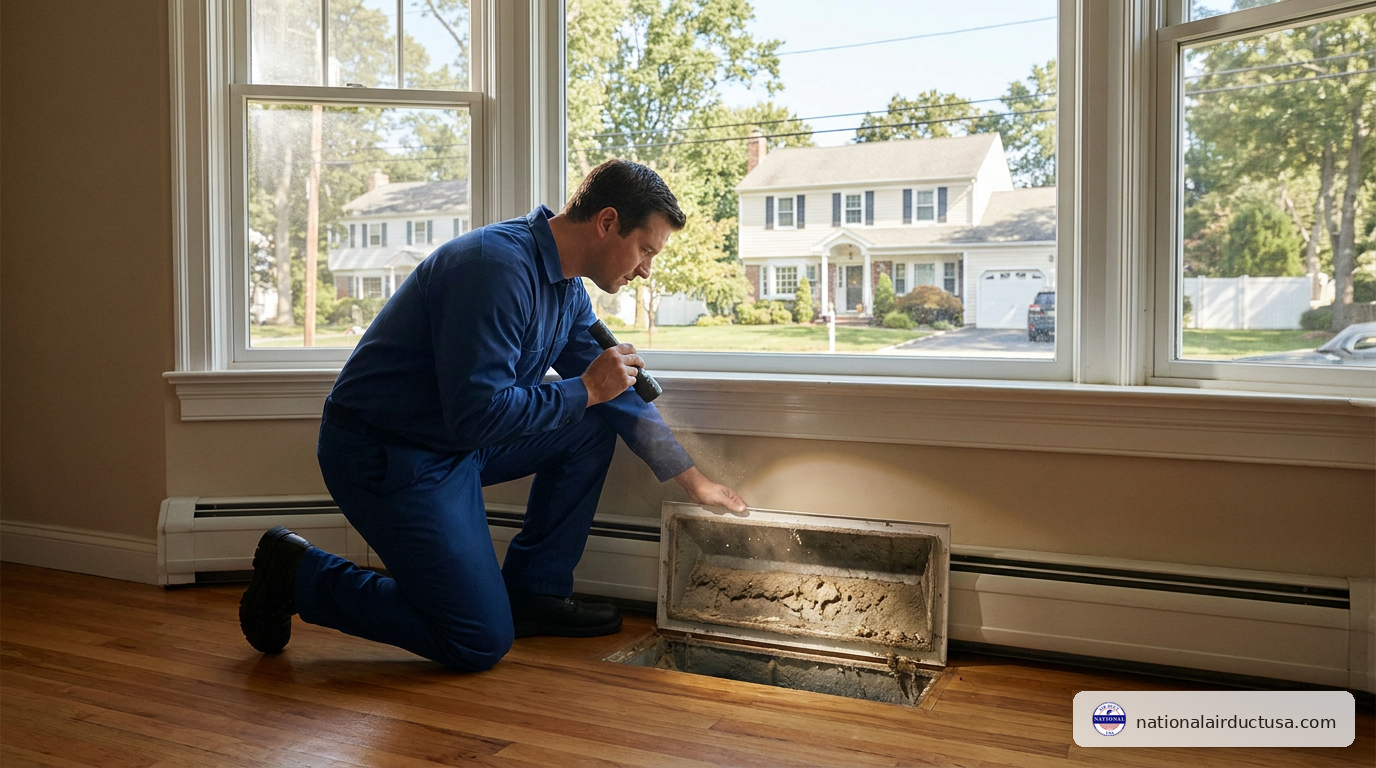
Ordinary dust in air ducts is not proven to cause illness, but dirty air ducts can make you sick in Long Island NY when they contain active mold, standing moisture, pest debris, or heavy contamination that gets circulated into living spaces. The real risk factor is not dust buildup itself, it’s moisture and biological growth, both of which are common in Long Island’s humid, coastal climate. Families with asthma, allergies, young children, or older adults are most likely to notice symptoms when HVAC systems are contaminated.
Every fall, as Long Island homeowners switch their HVAC systems from air conditioning to heat, thousands of households report a familiar pattern: sneezing, coughing, stuffy noses, and a vague sense that “something in the air” just changed. The question on many minds is simple: can dirty air ducts make you sick in Long Island NY? The honest answer is more nuanced than yes or no. According to the U.S. Environmental Protection Agency, duct cleaning has not been scientifically shown to prevent health problems, and routine cleaning is not recommended unless there’s evidence of a specific issue like mold, pests, or heavy contamination.
That distinction matters enormously for homes across Nassau and Suffolk counties, where humid summers, older housing stock, and coastal storm exposure create the exact conditions that turn ordinary ductwork into a genuine health hazard. This article breaks down the science, the local risk factors, and what actually separates “dusty but harmless” from “dangerous and in need of professional attention.”
What Does the Scientific Evidence Actually Show?
The research is clearer than most marketing claims suggest. Controlled studies have not established that cleaning typically dusty ducts prevents respiratory illness, resolves allergy symptoms, or meaningfully reduces indoor particle levels on its own. The EPA’s guidance on residential duct cleaning explicitly states that duct cleaning should be performed only when there’s visible evidence of mold, pest infestation, or excessive debris release, not on a fixed calendar schedule.
That said, the EPA and other federal health agencies are equally clear that HVAC systems can become a genuine source of indoor air quality problems. The EPA’s overview of indoor air pollution for health professionals notes that contamination becomes a health issue specifically when filtration is inadequate, moisture accumulates, or maintenance has been neglected for extended periods. In other words: it’s not the dust itself, it’s what grows in the dust when conditions are wrong.
How Do Dust, Mold, and Debris in Ducts Affect Your Body?
When ductwork contains active mold colonies, the health effects are well documented. The CDC’s overview of mold and health lists common reactions including nasal and sinus congestion, sore throat, coughing, wheezing, eye irritation, and skin irritation. For people who are mold-sensitive, symptoms can escalate to chest tightness and shortness of breath.
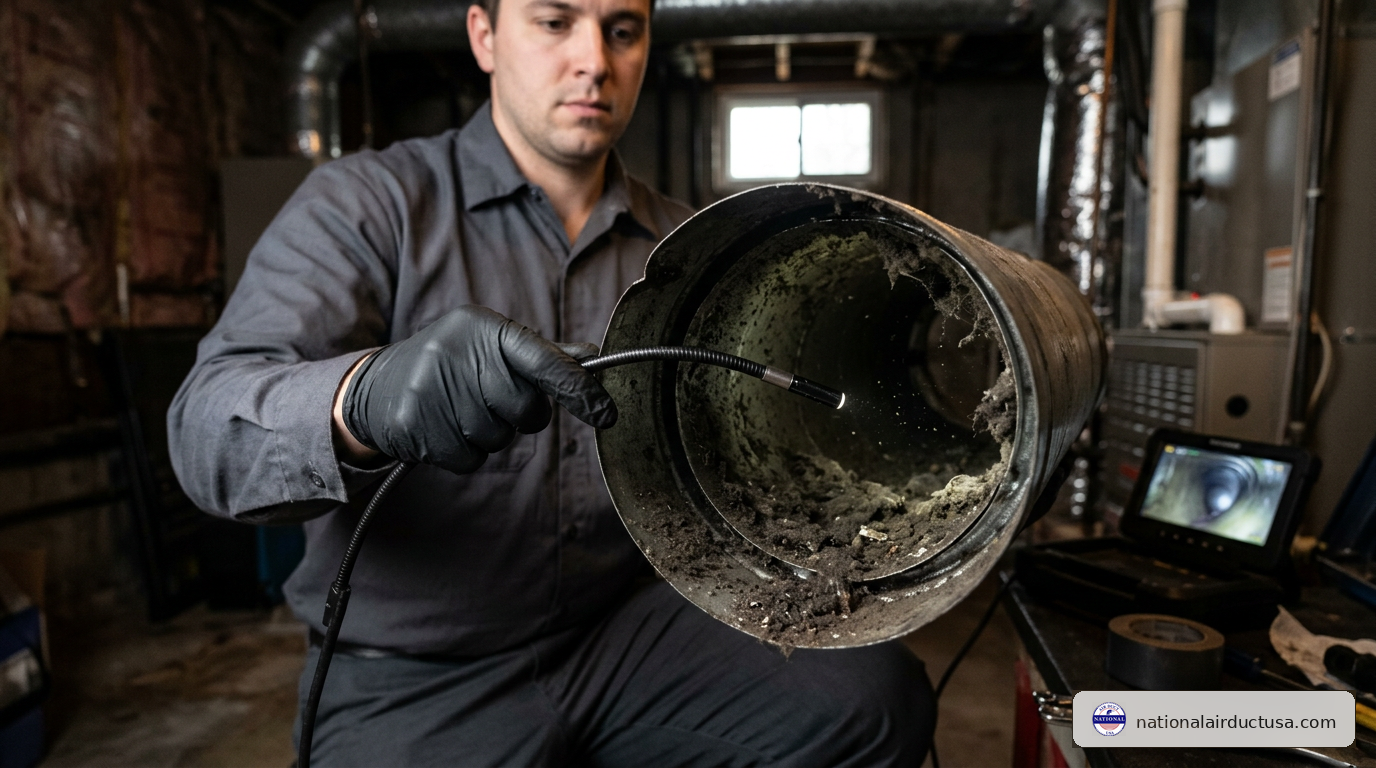
Mold is not the only biological concern. Dust mites, pet dander, pollen, rodent droppings, and insect debris can all accumulate in ductwork, particularly in homes with pets, older insulation, or infrequent filter changes. These particles don’t need to be inhaled in massive quantities to trigger a reaction in sensitive individuals; repeated low-level exposure over weeks or months is often enough to produce chronic symptoms that people mistake for seasonal allergies or a lingering cold.
“The question isn’t whether ducts hold dust, every duct does. The question is whether that duct is harboring moisture or mold that gets redistributed every time the blower turns on. That’s the line between a cosmetic issue and a health issue.”
Why Is Long Island’s Climate a Special Risk Factor?
Long Island’s geography creates a near-perfect storm for HVAC moisture problems. The region’s humid summers push air conditioning systems into near-constant operation for months, generating condensation around cooling coils and drain pans. When drain lines clog or coils aren’t maintained, that moisture has nowhere to go except into surrounding ductwork and insulation.
Coastal storm activity adds another layer of risk. Homes in flood-prone areas of Nassau and Suffolk counties, including communities near the South Shore and parts of the North Shore, have experienced basement and crawl-space flooding that can saturate ductwork and HVAC components for days before anyone notices. Add in Long Island’s older housing stock, much of it built decades before modern vapor barriers and sealed duct systems became standard, and you have a landscape where Long Island air quality is shaped as much by what’s happening inside homes as by outdoor pollution.
| Condition | Health Risk Level | Common Long Island Trigger |
|---|---|---|
| Ordinary household dust in ducts | Low, not proven to cause illness | Normal occupant activity, pets |
| Mold growth from condensation | High | Humid summers, clogged drain pans |
| Water-damaged ductwork after storms | High | Coastal flooding, heavy rainfall |
| Rodent or pest debris in ducts | Moderate to high | Older homes, unsealed crawl spaces |
Who Is Most at Risk From Contaminated Ducts?
Not every household reacts the same way to the same duct conditions. Federal health data consistently points to several higher-risk groups: children, older adults, people with asthma or allergies, and anyone with a compromised immune system. The CDC’s guidance on mold exposure and respiratory health notes that mold-sensitive individuals may experience sneezing, a runny or blocked nose, red or itchy eyes, skin rashes, coughing, chest tightness, and wheezing when exposed to elevated mold levels.
In rare cases, long-term exposure to severely contaminated HVAC systems has been linked to hypersensitivity pneumonitis, an inflammatory lung condition. This is uncommon, but it has been documented in cases tied to contaminated air conditioners, ductwork, and filters, underscoring why persistent, unexplained respiratory symptoms in a Long Island household should never be dismissed if a home’s HVAC system hasn’t been inspected recently.
Dirty Ducts vs. Real Exposure: What’s the Difference?
Here’s a detail most homeowners miss: contamination inside a duct is not automatically the same as exposure inside your living room. A significant amount of settled debris clings to duct surfaces and interior insulation rather than becoming airborne every time the system runs. The EPA’s technical review of duct cleaning effectiveness notes that everyday indoor activities, cooking, vacuuming, smoking, even foot traffic, can generate more airborne particles than typical duct dust does.
This is why some Long Island homes with visibly dusty ducts have no symptoms at all, while others with seemingly clean-looking vents have ongoing respiratory complaints traced to outdoor pollution, humidity, or sources unrelated to the HVAC system. Determining the real cause matters because cleaning ducts that aren’t actively distributing contaminants into occupied space won’t resolve symptoms rooted elsewhere.
What Warning Signs Suggest Your Ducts Need Attention?
Certain red flags shift a duct system from “probably fine” to “needs professional evaluation.” These are the signs worth taking seriously:
- Visible mold around vent covers, inside return grilles, or on exposed ductwork in a basement or attic.
- Musty or mildew odors that intensify when the HVAC system first turns on.
- Recent water damage from a leak, flood, or burst pipe near ductwork or the air handler.
- Visible pest activity, droppings, nests, or insect debris inside vents or the furnace cabinet.
- Household members developing symptoms that improve when away from home and return shortly after coming back.
- Excessive dust blowing visibly from vents or settling unusually fast on nearby surfaces.
If any of these apply, it’s worth reviewing the more detailed breakdown in 7 signs you need air duct cleaning in New York, which expands on how to tell cosmetic dust apart from an active problem.
What Should Long Island Homeowners Do Next?
The right response depends on what’s actually happening inside the system. If there’s no visible mold, no water damage, and no pest activity, routine dust alone generally doesn’t justify emergency action, though regular filter changes and a solid HVAC maintenance checklist go a long way toward prevention. If there’s visible mold, water staining, or a persistent musty smell, a professional inspection becomes the priority, especially in homes that combine ducts with mold concerns, which is covered in depth in this guide to air duct cleaning and mold removal in New York.
Pricing for professional duct inspection, cleaning, or mold remediation varies widely, generally ranging from a few hundred dollars for a basic system evaluation to several thousand dollars for full-system cleaning, sanitizing, and mold remediation on larger or heavily contaminated homes. The final cost depends on system size, the extent of contamination, accessibility, and whether mold treatment or component replacement is needed. Because every Long Island home’s HVAC footprint is different, the most reliable way to know your actual cost is to request a custom quote after an on-site evaluation.
“We don’t recommend cleaning every duct system we inspect. We recommend cleaning the ones that actually show mold, moisture damage, or pest contamination. That’s the standard the EPA sets, and it’s the standard we hold ourselves to on every Long Island job.”
Key Takeaways
- Ordinary dust buildup in ducts has not been proven to cause illness; the real risk comes from mold, moisture, and biological contamination.
- Long Island’s humid summers and storm exposure make condensation and water intrusion the top HVAC health risks in the region.
- Children, older adults, and people with asthma or allergies are the most likely to notice symptoms from contaminated systems.
- Contamination inside a duct doesn’t always equal exposure; indoor activity and outdoor pollution often play a bigger role in symptoms.
- Visible mold, musty odors, recent water damage, or pest activity are the clearest signs a duct system needs professional evaluation.
- Duct cleaning should be evidence-based, not scheduled automatically, according to EPA guidance.
- Professional inspection is the most reliable way to distinguish a cosmetic dust issue from a genuine health hazard.
People Also Ask
Can dirty air ducts cause respiratory problems?
Dirty ducts can contribute to respiratory problems when they contain active mold, moisture damage, or heavy biological contamination that gets circulated into living spaces. Ordinary dust alone is not proven to cause respiratory illness, but mold-sensitive individuals can develop coughing, wheezing, or congestion from contaminated systems.
How do I know if my air ducts are making me sick?
Look for symptoms that improve when you’re away from home and return after you’re back, combined with visible mold, musty odors, or water damage near ductwork. A professional inspection is the most reliable way to confirm whether the HVAC system is the actual source.
Does mold in air ducts spread through the whole house?
Yes, if mold is present in ductwork that’s connected to a central HVAC system, spores can be distributed to every room the system serves whenever the blower runs. This is one of the primary reasons mold in ducts is treated more seriously than mold in an isolated area.
Is it worth cleaning air ducts for allergies?
Duct cleaning helps allergy symptoms mainly when ducts contain significant pet dander, pest debris, or mold rather than ordinary dust. For many allergy sufferers, improving filtration and addressing indoor humidity provides more consistent relief than duct cleaning alone.
Frequently Asked Questions
Can dirty air ducts make you sick in Long Island NY?+
Dirty ducts can make you sick in Long Island NY primarily when they contain active mold, standing moisture, or pest contamination rather than just ordinary dust. The region’s humid climate and coastal storm exposure make moisture-driven mold the most common real-world trigger for HVAC-related symptoms.
How often should Long Island homeowners get their ducts checked?+
There’s no universal schedule, but homes with recent water damage, visible mold, or pest activity should be inspected right away. For general guidance on timing, see this breakdown on how often you should clean air ducts in Long Island NY.
Does the EPA recommend regular duct cleaning?+
No. The EPA recommends duct cleaning only when there is visible evidence of mold, pest infestation, or substantial debris, not on a fixed routine schedule, because cleaning typical dusty ducts hasn’t been shown to prevent illness.
Can a dirty dryer vent also affect indoor air quality?+
Yes, a clogged or dirty dryer vent can push lint, moisture, and combustion byproducts back into the home rather than venting them outside. For a full overview, see this dryer vent cleaning guide for Long Island NY homeowners.
What’s the difference between dusty ducts and moldy ducts?+
Dusty ducts contain settled particles like skin cells, fibers, and dirt that are largely inert and not proven to cause illness on their own. Moldy ducts contain active biological growth fueled by moisture, which can release spores capable of triggering respiratory and allergic symptoms.
Should I get a professional inspection before booking duct cleaning?+
Yes, a visual inspection helps confirm whether mold, moisture, or pest contamination is actually present before any cleaning is scheduled. You can review the typical process in this guide to professional air duct cleaning near me in Long Island NY.
Can outdoor pollution be mistaken for a duct problem?+
Yes, outdoor pollutants like traffic pollution, pollen, ozone, and seasonal particulate matter can enter homes and cause symptoms that get mistakenly blamed on dirty ducts. Reviewing local Long Island air quality conditions can help clarify whether outdoor air is contributing to symptoms.
Related: How to Improve Indoor Air Quality in Long Island NY
Related: Why Your Ducts Are Leaking Water: Long Island NY Solutions
Related: Air Duct Cleaning for Pet Hair and Dander in New York: A Trust-First Guide for Pet Owners
If you’ve noticed musty odors, visible mold, recent water damage, or unexplained respiratory symptoms in your Long Island home, don’t guess. Learn more about our approach on our about us page, browse real before-and-after results in this Long Island before and after duct cleaning guide, or visit National Air Duct to schedule a professional inspection. You can also reach our team directly through the contact page to get a custom quote based on your home’s specific HVAC conditions.
Further reading: Signs of Mold in Air Ducts: What Long Island NY Homeowners Must Know