Quick Answer
Reputable CT air duct cleaning in Long Island NY means hiring contractors who follow NADCA’s 2021 cleaning standard, carry verifiable insurance and certification, and perform a documented inspection before recommending service. The EPA advises cleaning only when there is visible mold, heavy debris release, or vermin infestation, not on a fixed calendar schedule. Homeowners should always ask for proof of certification, written scope of work, and before-and-after documentation before any technician touches their ductwork.
Here’s a number that surprises most homeowners: there is still no authoritative national data proving that routine residential duct cleaning improves health outcomes or lowers energy bills in every home. That doesn’t mean duct cleaning is worthless. It means the entire value of the service rests on who is doing it and why. When homeowners search for CT air duct cleaning in Long Island NY, whether they mean a Connecticut-based crew or simply a “CT-style” split HVAC system common to colonial and cape-style homes, the real question isn’t about geography. It’s about whether the contractor they hire actually follows the standards that separate a legitimate job from an expensive vacuum pass.
This article isn’t a sales pitch. It’s a breakdown of the licensing, certification, equipment, and warranty standards that distinguish a trustworthy duct cleaning company from one that shows up with a shop vac and a van wrap.
What Does “Licensed” Actually Mean for Duct Cleaners?
Unlike electricians or plumbers, duct cleaning in New York State does not require a dedicated state-issued trade license in most counties. This gap is exactly why industry certification and business licensing matter more, not less. A legitimate contractor operating on Long Island should carry a general contracting or home improvement license through Nassau or Suffolk County, general liability insurance, and workers’ compensation coverage for every technician on the crew.
“Licensed” should also mean the company is registered to do business in New York, carries the insurance to back up any accidental damage claim, and can produce documentation on request. If a company can’t show proof of insurance within a day of asking, that’s a disqualifying red flag, not a minor inconvenience.
Why Does NADCA Certification Matter More Than Price?
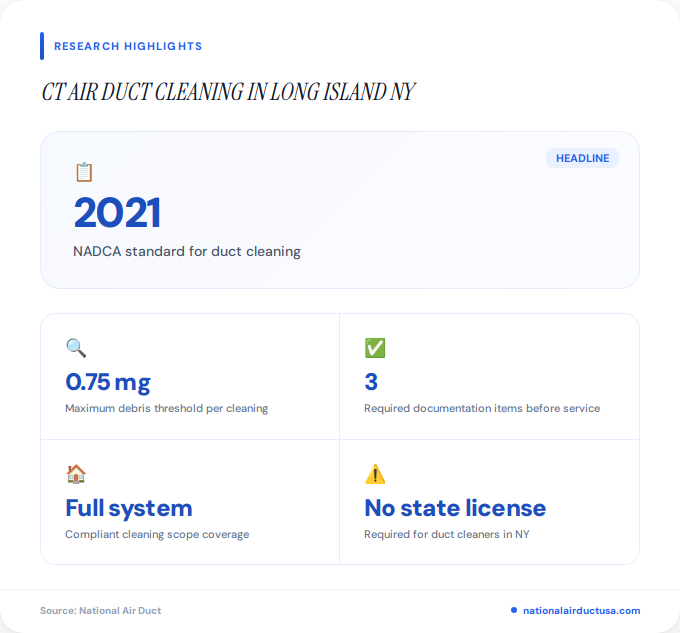
The National Air Duct Cleaners Association (NADCA) is the industry’s primary credentialing body, and its 2021 standard defines cleaning as the removal of non-adhered substances from HVAC components, paired with verification procedures to confirm the job actually worked. According to NADCA’s published guidance on proper cleaning methods, a compliant job doesn’t stop at the supply vents. It covers the full airside system: ducts, coils, drain pans, registers, grilles, plenums, blower assemblies, heat exchangers, filters, and air cleaners.
NADCA’s vacuum cleanliness test sets a maximum debris threshold of 0.75 mg per 100 cm² of filter media after cleaning, giving technicians an objective, measurable benchmark instead of a visual “looks clean” guess. Companies that invest in this certification send technicians through classroom and field training, renew credentials periodically, and agree to a code of ethics that discourages scare-tactic sales. That’s a meaningfully different experience than hiring whoever answers the phone fastest.
What Equipment Standards Separate Pros From Amateurs?
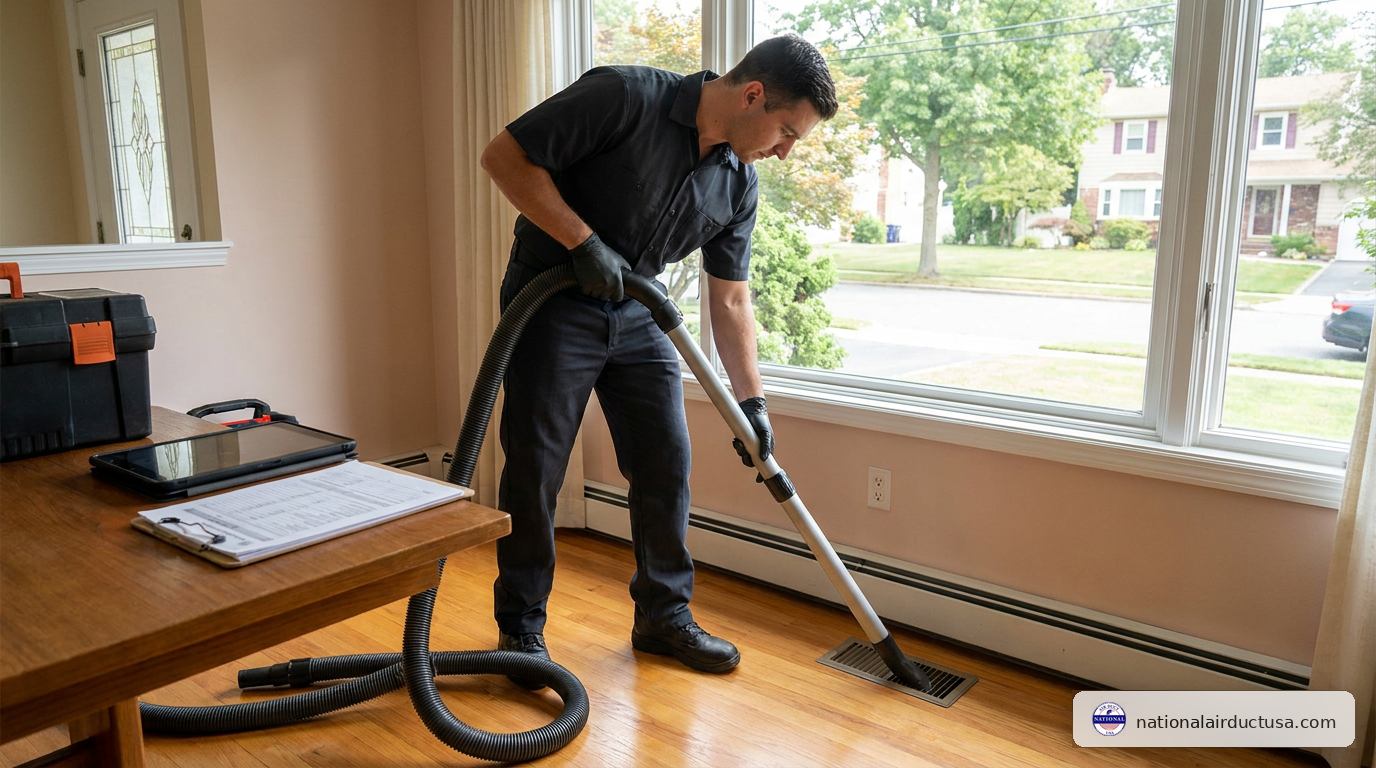
Equipment quality is one of the clearest tells of experience level. A compliant duct cleaning uses negative-pressure HEPA-filtered vacuum systems, rotary brushes or air whips sized correctly for the duct material, and sealed collection points so debris never gets pushed back into living spaces. Inexperienced operators often use undersized portable vacuums that simply stir dust around without full extraction.
- Negative air machines: Create continuous suction through the whole duct run so loosened debris is pulled out, not redistributed.
- HEPA filtration on exhaust: Prevents fine particulate from re-entering the home through the cleaning equipment itself.
- Material-appropriate agitation tools: Fiberglass-lined duct requires gentler brushing than sheet metal to avoid damaging the liner, consistent with NAIMA guidance referenced by the EPA.
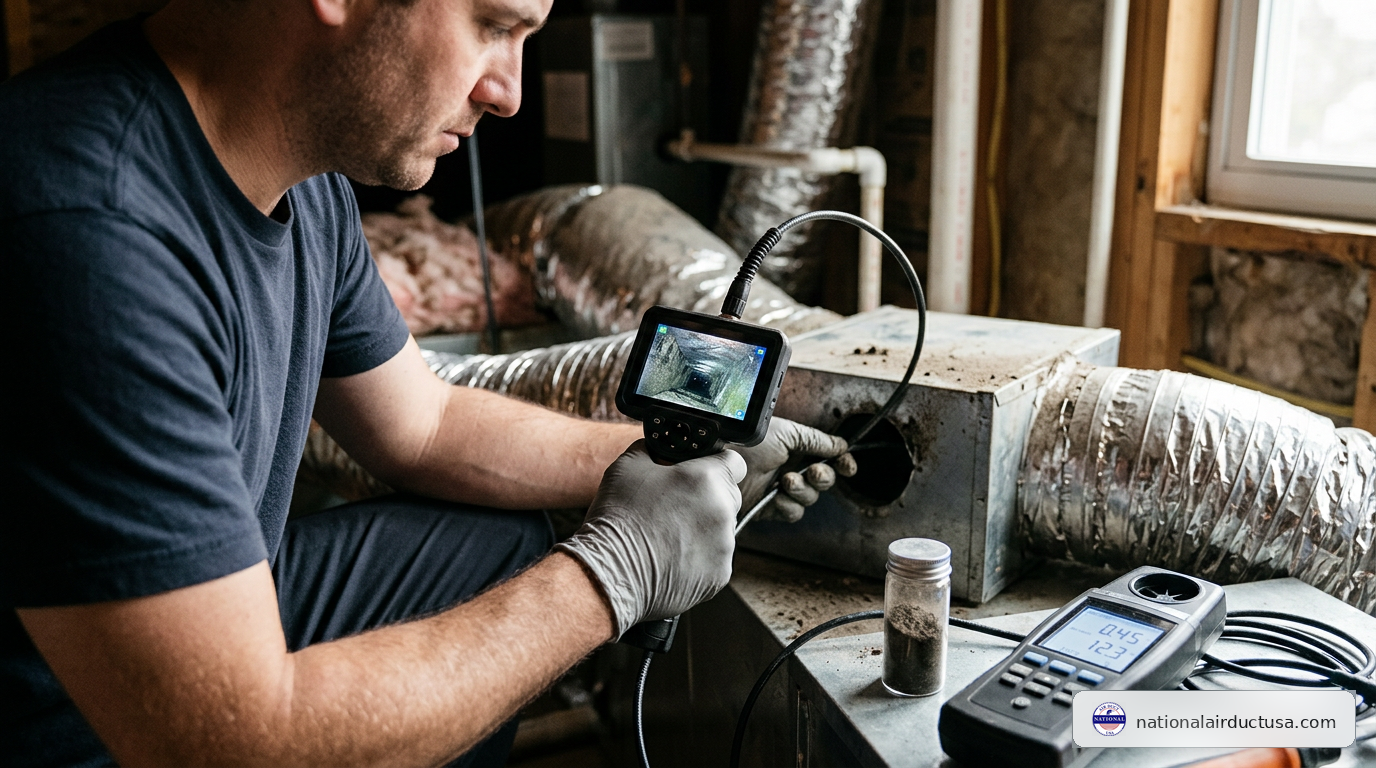
- Inspection cameras: Allow before-and-after video documentation instead of a verbal assurance that “it’s done.”
A homeowner evaluating a quote for air duct cleaning should ask specifically what equipment will be used and whether photo or video documentation is included. If the answer is vague, that’s worth noting.
How Do Long Island’s Housing Conditions Change the Job?
Long Island’s housing stock creates unique duct cleaning challenges that a generalist contractor from outside the region may not anticipate. Nassau and Suffolk homes frequently combine older construction, additions built decades apart, basements, crawl spaces, and attic air handlers, often with mixed ductwork materials installed across multiple renovations. A cookie-cutter “whole-house flat rate” approach ignores this complexity.
Coastal humidity is a major factor. Homes near the North Shore, the South Shore, and barrier communities can experience elevated basement dampness and condensation around poorly insulated ductwork, conditions where moisture, not ordinary dust, is the real concern when evaluating suspected mold growth. Homeowners dealing with musty odors or visible growth should read our step-by-step mold removal checklist for Long Island ductwork before assuming a standard cleaning will resolve it.
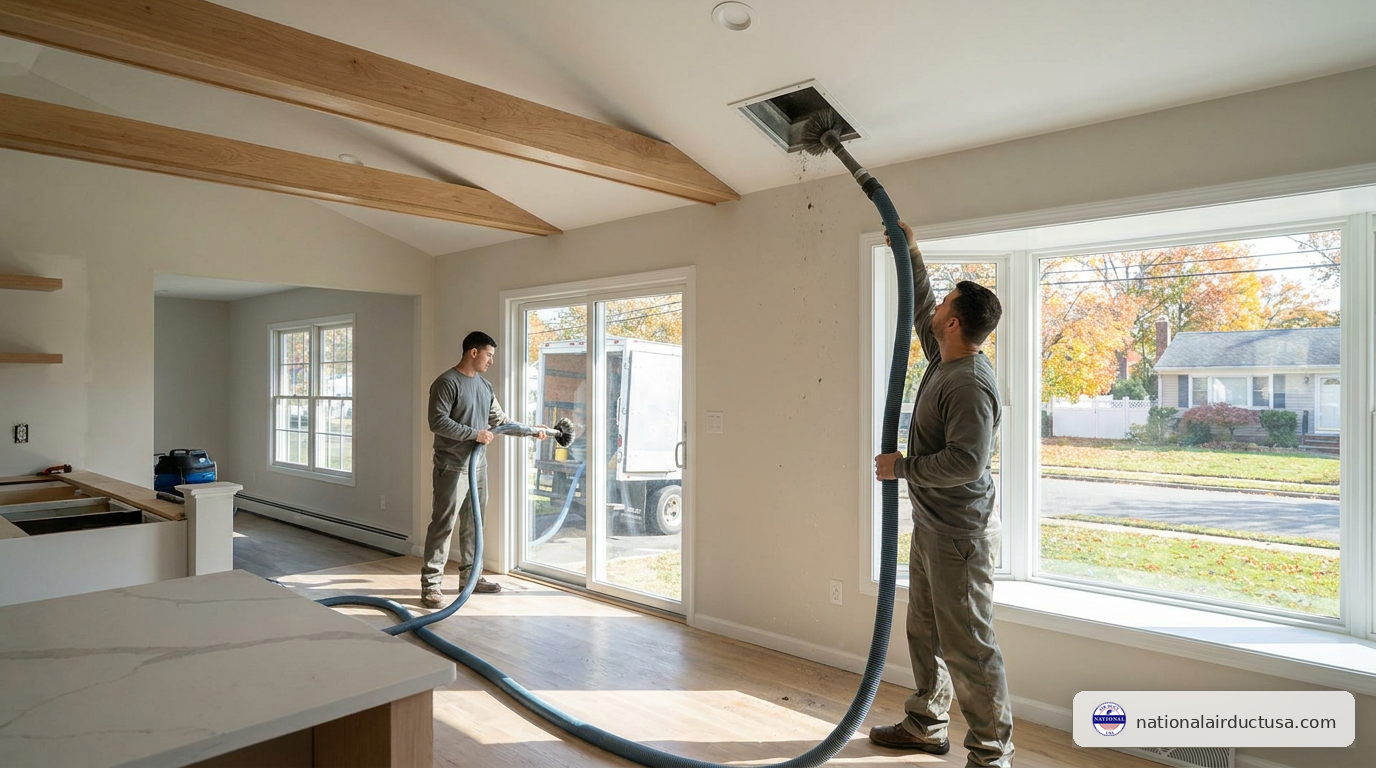
Post-renovation debris is another common Long Island scenario. Sanding dust, drywall particles, and insulation fibers frequently enter open duct systems during kitchen remodels or additions, a pattern covered in more depth in our post-construction deep cleaning cost guide. Homes with oil-fired heating systems also need special attention, since soot and combustion byproducts near the furnace or boiler require coordination with burner service and chimney inspection, not just duct vacuuming. For more on seasonal heating safety, see our boiler and chimney fire safety checklist.
| Factor | Certified/Licensed Contractor | Uncertified Operator |
|---|---|---|
| Pre-service inspection | Camera-documented, written findings | Visual glance, verbal estimate only |
| Equipment | HEPA negative-air systems | Standard shop vacuum |
| Scope of work | Full airside system per NADCA | Supply vents only |
| Insurance/warranty | Documented, verifiable | Often undisclosed or absent |
What Warranty Protections Should Homeowners Expect?
A reputable company stands behind its work with a written warranty covering both labor and any accidental damage to ductwork, drywall, or flooring during access. At minimum, homeowners should expect a satisfaction guarantee that allows a callback if visible debris or odor persists shortly after service, proof of liability coverage that would apply if equipment damages the home, and a clear written scope of work specifying exactly which components were cleaned.
Pricing for a properly scoped job varies widely, generally $10,000 to $50,000+ for larger commercial or complex multi-system residential properties, and considerably less for standard single-family service, depending on duct accessibility, system size, contamination level, and whether dryer vents or additional components are included. Pricing varies based on your specific project, and any contractor quoting an exact number over the phone without seeing the system should be questioned. Always request a custom quote after an in-person or video-documented inspection.
How Can You Verify a Contractor’s Credentials Before Booking?
Verification takes five minutes and can save thousands of dollars in disappointment or damage. Ask for the contractor’s NADCA membership number and check it against NADCA’s member directory. Request a current certificate of insurance naming you, the homeowner, and confirm it hasn’t lapsed.
- Ask directly: “Are your technicians NADCA certified, and can you provide documentation?”
- Request a copy of general liability and workers’ compensation insurance.
- Confirm the company is registered to do business in New York and licensed in Nassau or Suffolk County if required for home improvement work.
- Ask whether the inspection will be documented with photos or video before any cleaning begins.
- Read recent reviews specifically mentioning thoroughness, not just friendliness or price.
Homeowners who want a deeper walkthrough of what a compliant visit actually looks like step by step should review what happens during a professional duct cleaning appointment before scheduling anything.
What Red Flags Signal an Inexperienced Contractor?
The EPA’s current guidance, detailed in its official duct cleaning guidance page, states cleaning should generally happen only when needed, such as visible mold on hard-surface ducts, substantial dust or debris actively being released into rooms, or vermin infestation, not on an arbitrary annual schedule. A contractor who insists you need cleaning every year regardless of inspection findings is prioritizing revenue over your actual situation.
Other red flags include advertised prices that are dramatically below the regional norm (often a bait to upsell once technicians are inside your home), refusal to show before-and-after photos, and technicians who cannot explain which specific components, coils, plenums, blower assembly, will be addressed. The EPA’s archived 1997 guidance, preserved in this historical EPA snapshot, has long cautioned consumers against companies making sweeping health claims without supporting evidence, a caution that still applies today.
If you’re unsure whether your home even needs service yet, our guide on signs you need duct cleaning services in Long Island walks through the specific symptoms worth watching for before you call anyone.
Key Takeaways
- The EPA recommends duct cleaning only when there’s visible mold, heavy debris release, or vermin, not on a fixed yearly schedule.
- NADCA’s 2021 standard sets a measurable cleanliness benchmark of 0.75 mg per 100 cm² and requires cleaning the entire airside system, not just supply vents.
- Licensed, certified contractors carry verifiable insurance, use HEPA negative-air equipment, and document work with photos or video.
- Long Island’s coastal humidity, older construction, and mixed duct materials demand an individualized inspection, not a flat-rate package.
- Oil-fired heating systems require separate combustion, chimney, and carbon monoxide checks; duct cleaning does not replace these safety services.
- Always verify NADCA membership, insurance documentation, and written scope of work before authorizing any service.
- Pricing should always follow an inspection, never be quoted sight-unseen for a complex system.
People Also Ask
Is duct cleaning regulated by the state of New York?
New York does not issue a specific statewide duct cleaning license, which is why industry certification through NADCA and proper business/contractor registration in Nassau or Suffolk County matter so much when vetting a company.
How do I know if my Long Island home actually needs duct cleaning?
Look for visible mold on hard-surface ducts, dust actively blowing from vents, or signs of pests, per EPA guidance. A professional inspection with camera documentation is the most reliable way to confirm before paying for service.
What does NADCA certification require?
NADCA certification requires technicians to complete classroom and field training, follow a published cleaning standard covering the full airside system, and agree to a code of ethics that discourages unnecessary upselling.
Does duct cleaning help with allergies or asthma?
The EPA notes there is no authoritative data proving routine duct cleaning improves health outcomes in every home, though removing visible mold, debris, or infestation sources may help in specific documented cases.
Frequently Asked Questions
What should I ask before hiring a duct cleaning company on Long Island?+
Ask for NADCA certification numbers, proof of liability insurance, a written scope of work, and whether before-and-after documentation is included. A company that hesitates on any of these questions warrants extra caution.
Does duct cleaning cover dryer vents too?+
No, dryer vent cleaning is a separate service with its own fire-safety standards and equipment needs. See our dedicated guide on dryer duct cleaning in Long Island for details specific to that system.
How often should Long Island homeowners get their ducts inspected?+
There’s no universal fixed schedule; inspection frequency depends on home age, renovation history, and humidity exposure. Our guide on how often you should clean air ducts in Long Island breaks this down by home type.
Can dirty ducts actually raise my energy bills?+
It depends on the degree of blockage and system efficiency loss; our article on whether dirty air ducts increase energy bills in Long Island walks through the mechanics and when it’s actually a factor.
What’s the difference between a basic vacuum service and a full NADCA-compliant cleaning?+
A basic vacuum service often addresses only visible, accessible vents, while a NADCA-compliant job cleans the entire airside system, coils, plenums, blower assembly, and uses measurable cleanliness verification. The difference typically shows up in how long results last.
Should I worry about mold in my ducts if I live near the Long Island coast?+
Coastal humidity does raise the risk of condensation and basement dampness around poorly insulated ductwork, which can contribute to mold growth. A visual inspection by a qualified technician is the right first step rather than assuming cleaning alone will solve it.
Where can I find a trustworthy duct cleaning provider near me on Long Island?+
Start with a provider’s documented certifications and reviews, and compare them against the standards outlined in our guide to finding duct cleaning near you as a Long Island homeowner.
Related: Professional Duct Cleaning Checklist: What’s Actually Included in Long Island, NY
Trustworthy duct cleaning isn’t about finding the lowest bid, it’s about confirming a contractor follows documented standards, carries real insurance, and can explain exactly what they’re doing and why. For a deeper dive into the full process and regional considerations, read our complete Long Island air duct cleaning guide, or explore service-area specifics like air duct cleaning in Westbury, NY. You can also learn more about indoor air conditions across the region in our Long Island air quality overview. When you’re ready to have your system properly evaluated, visit National Air Duct or contact our team to schedule a documented, no-pressure inspection.
Further reading: Why Are My Air Ducts So Dusty in Long Island NY?
Further reading: Get an Air Duct Cleaning Cost Estimate: A Homeowner Checklist for Long Island, NY
Further reading: Air Duct Cleaning After Construction in Long Island NY: 5 Questions Answered
Further reading: Air Duct Cleaning Nassau County NY: Process, Cost, and Results for Long Island Homeowners